This week at Nothing in Biology Makes Sense! Making sense of genome reduction.
There was/wasn’t something in the air. How giant prehistoric insects went extinct.
Sounds like a mess, if an entertaining one. The “science” of Prometheus.
Baking soda in my sauteed onions? Okay, then. Pretty much everything great about cooked food comes down to one chemical reaction.
Once you know what to look for, you see it everywhere. Mounting evidence that the recent increase in autism diagnoses is due to changes in diagnostic practice.
We live on geology. The billion-year geologic history that created an Arizona mining town.
He’s gonna need a bigger chainsaw. Carl Zimmer tries to slay a zombie meme.
Memo to scientists: Don’t be dicks about making research results interesting to lay people.
Difference this will make in the debate about birth control access: zero. Turns out that the “morning-after” pill doesn’t prevent fertilized eggs from implanting in the uterus—it actually prevents eggs from being fertilized in the first place.
The monthly roundup of evolution-related online writing is (finally) live at Pharyngula, now that host P.Z. Myers is back from a trip to Iceland. P.Z. indulges his hominid cognitive biases by sorting the contributed links into neat, if somewhat idiosyncratic, categories: Bacteria, Plants, Charismatic Megafauna, Humans, Charismatic Organs in Charismatic Megafauna (i.e., mostly brains and penises), Theory, History, and Idiots. Take a moment to speculate as to where my own contributions were classified, and then head over to the Carnival for posts from worthier sources including Jerry Coyne, Anne Gutmann, and Arvind Pillai.◼
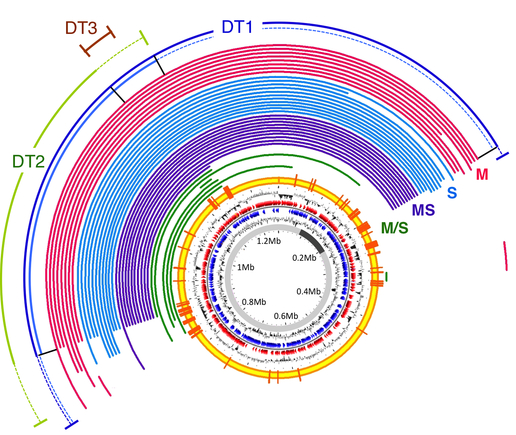
Over at the collaborative science blog Nothing in Biology Makes Sense!, guest contributor Levi Morran examines the processes by which bacteria can lose genes over generations of evolution.
In a recent paper, Lee and Marx (2012) test both how and why they observe large-scale patterns of gene loss in their experimentally evolved populations of Methylobacterium extorquens. They evolved these bacterial populations under different treatments of resource availability (realms of specialization) and found that all replicate populations adapted to their specific treatment over 1,500 generations. During experimental evolution, 80% of the bacterial populations exhibited nearly a 10% reduction in genome size, and many of the gene losses occurred in similar regions of the genome, some even across treatments.
In case you think I was kind of an asshole in my response to that study about female vulnerability and sexual explitability (and, fine, I was; but I’d like to think I was channeling my natural asshole-ness for a righteous and scientifically important cause), here are some non-scientists taking many of the same issues with that very study, and coming up with even more basic questions about its logic:
I had a great run this morning! As noted yesterday, it was the 2012 Minneapolis Marathon. My final time was 3:33:37, which isn’t the personal record I’d hoped for on a flat course in nice weather, but I’m happy with it.
I took my iPhone with me, and tweeted photos along the course. And, just for the heck of it, I’ve put all the tweets (and encouragement/kudos/responses) together with some additional notes and context in a Storify. Enjoy!
Jeremy runs the 2012 Minneapolis Marathon
26.2 miles, tweeted.
Storified by Jeremy Yoder · Sun, Jun 03 2012 16:20:50
The 2012 Minneapolis Marathon was my fourth marathon, and my first springtime one. A mild winter made the training-up a lot easier, and the early June race date meant the weather should was tolerable, before everything goes all Minnesota-tropical for the summer. And, since I took my iPhone along for run-time tunes and podcasts, I could live-tweet photos of the course as I ran!
Long run tomorrow http://nblo.gs/yjHZQJeremy Yoder
And folks offered good wishes and advice:
@JBYoder good luck. Remember hydration is your friendDr. Wrasse
Thanks! And, always. RT @labroides: @JBYoder good luck. Remember hydration is your friendJeremy Yoder
Also, I did some carb-loading. Too much? Turns out it wasn’t.
Even though I’m running a marathon tomorrow morning, that double slice of leftover chocolate cake was probably a bad idea. #CarbOverLoadingJeremy Yoder
@JBYoder Naaah…plenty of time to digest. Good luck! More important: have fun! :)NatC
@SciTriGrrl Thanks! I’m sure I’ll be glad of the glycogen tomorrow morning.Jeremy Yoder
@JBYoder Well good luck!Giuseppe Gangarossa
I woke up at 5 a.m. to grab breakfast, then walked to the starting line in downtown Minneapolis. I love the view from the Hennepin Bridge.
Walking to the marathon. http://pic.twitter.com/rFtBIZYLJeremy Yoder
I got to the start a bit after 6 a.m., and people were already gathering.
http://pic.twitter.com/d4HaZSieJeremy Yoder
Ready to go, in … 19 min. http://pic.twitter.com/HFNvEbgcJeremy Yoder
@JBYoder good luck!Bastian Greshake
http://pic.twitter.com/RAvZro60Jeremy Yoder
At 6:30 a.m. on the nose, we were off. We ran through downtown, then turned down onto the riverfront road, first heading north to Broadway for a turnaround. And then it was long way south. My playlist was
“Olympic Fanfare and Theme,” by John Williams, which is great for that starting motivation.
“Barbra Streisand,” by Duck Sauce—good for setting up a pace in the first mile.
The Slate Political Gabfest, because I listen to podcasts on all my training runs, and so they go in my marathon playlist, too.
And then, about an hour in, I remembered to take photos.
And then another podcast, NPR’s new puzzle show Ask Me Another, which provided some welcom distraction in the third hour.
Here’s the actual Fort Snelling, I believe. This was right after a hill that regained something like 75% of the elevation we’d lost on the way down to the river in maybe 300 meters. That slowed everyone waaay down.
http://pic.twitter.com/mVEUSbNNJeremy Yoder
Loving @JBYoder’s photos from his marathon this morning. Run, Jeremy, run!science_goddess
Mile 21: I’m definitely slowing down.
http://pic.twitter.com/9EwEmJP9Jeremy Yoder
No more podcasts, now. The playlist is entirely devoted to tracks that’ll help me keep putting one foot in front of the other. And my motivational music skews nerdy, as you might guess:
“To Boldly Go” and
“End Credits,” both by Michael Giacchino, from the soundtrack of the latest “Star Trek” movie.
For the home stretch, I have Cake’s cover of “I Will Survive” in the playlist, and boy do I need it. It’s gotten hot! But here comes the Washington Avenue Bridge …
http://pic.twitter.com/irXAwAqpJeremy Yoder
And finally, the finish line. Appropriately enough, I crossed to “River Crossing,” from Carter Burwell’s awesome soundtrack to the Coen brothers’ awesome “True Grit.”
About 3:33. http://pic.twitter.com/PHFTUI4KJeremy Yoder
My final time turns out to be 3 hours, 33 minutes, and 37 seconds. Not a personal record, but not too shabby. The finisher medal is pretty nifty, too:
And I’m still alive. http://pic.twitter.com/PdJYXcS7Jeremy Yoder
And then, as soon as I was rehydrated, it was off to clean up for brunch with friends over in Saint Paul. Not a bad way to spend an early-summer Sunday, all things concerned.
Some more comments/kudos from the tweeps—thanks, everyone!
@JBYoder Congrats! Now please tell me that’s the white balance on your camera and not sunburn.Stephanie Zvan
Yeah, that was mostly the white balance. Although I was shirtless from about mile 17 on. The nice thing about a cheap tank top is you can ditch it when it gets sweat-logged and chafe-y.
Nicely done! Makes me wonder what I’ve been doing for the last 3.5 hrs RT @JBYoder: About 3:33. http://pic.twitter.com/4lkUFOPDRyan Kitko
@JBYoder congrats!! Great time!!NatC
Congrats! RT @JBYoder: And I’m still alive. http://pic.twitter.com/Yz3ET5wCGerty-Z
@JBYoder looks like it was a pretty scenic route. Congrats on your 4th Marathon! wish i had that dedicationJonathan Yoder
@science_goddess @Patrick_Clarkin @Bonovox1984 @SciTriGrrl @GertyZ @szvan Thanks for the encouragement! Made carrying my iPhone worth it!Jeremy Yoder
@GertyZ @JBYoder Woot!CackleofRad
@GertyZ @JBYoder (I think he just logged his #r4p)CackleofRad
Live-tweeting the running of a marathon?! @JBYoder is using lots of pictures to do it. Seems to be working. http://pic.twitter.com/OBVl7QUHRichard Harper
Live-tweeting the running of a marathon?! @JBYoder is using lots of pictures to do it. Seems to be working. http://pic.twitter.com/sytmQqRablake56x2
Next question: will my legs un-stiffen fast enough for me to get up the nerve to register for the Twin Cities Marathon in October?◼
Anyway, if all that doesn’t make you immediately want to watch, or if you’re about to leave a comment asking what, exactly, is a “redshirt,” then you probably should just wait for the next post.
*Caution: that link also includes a video of Scalzi covering the song on a ukelele, for which I refuse to vouch.◼
Specifically, the Minneapolis Marathon, which will be my fourth. Weather looks to be perfectly clear, and we’ll start at 6:30 in the morning, when it should be nice and cool. The course is basically my favorite regular training route, down along the riverside. With any luck, I might even get a personal record out of this.
I don’t know if I could watch a whole feature film like this, but it’s mighty pretty in two minutes-plus of full-screen viewing. And hey, just as I was wondering if there would be Joshua trees, there were Joshua trees.
And check out the casting: Hugh Jackman is Jean Valjean (yay!), Russell Crow is Javert (um, okay). The Thénardiers will be played by Sacha Baron Cohen and Helena Bonham Carter. And in a particularly nice touch, the Bishop of Digne will be played by Colm Wilkinson, who was Valjean in the 1985 cast.
 Enjoying tempura? Thank the Maillard reaction. Photo by christianyves.