The Molecular Ecologist: Crowd-sourcing natural history

Moths in an insect drawer Insects in a museum collection. Photo by Leeds Museum and Galleries.

This week at The Molecular Ecologist, I discuss some emerging initiatives to collect biodiversity data with a little help from the entire Internet:

… the websites iSpot and eBird ask volunteers to record their natural history observations directly, creating crowd-sourced records of species occurrences. (iSpot covers everything from amphibians to fungi, while eBird is specialized exactly as you would expect from the name.) Both of these sites provide educational resources in concert with their data-collection missions; iSpot through user-generated quizzes, eBird by helping bird-watchers find new species in their own neighborhoods. And both of them make their datasets public.

Have you ever worked with crowd-sourced data like this? Go read the whole thing, and tell us about your experience in the comments.◼

Science online, sticky tape and storytelling edition

2006.07.10 - storm's a'comin' Wilderness: still worth preserving. Photo by jby.

Queer in STEM: What’s the relationship between openness and comfort?


Faculty members who are out to their colleagues are … much more likely to describe themselves as “uncomfortable”? Figure 1 from Patridge et al. (2014).

Over at the Queer in STEM site, I discuss the first study to try and tackle the questions that motivated QiS, which was just recently published. It’s exciting to see that other folks are also looking at the experiences of LGBTQ folks in STEM careers—but it’s a bit puzzling that this new study found a pattern very different from what we see in our own data:

… of the STEM faculty who answered the Campus Pride survey, those who who rated their “outness” level as 4 or 5 were much more likely to say they were uncomfortable in their department.

… In the most comparable analysis from our own study, we found that participants who described their workplaces as “welcoming,” or said they were “treated the same” as their straight colleges, were much more likely to be out to their colleagues—exactly the opposite of the relationship Patridge et al. found between begin out and feeling comfortable.

In the full post, I discuss some hypotheses about why we might have found such completely different results, and try to evaluate them based on the Queer in STEM data.◼

The Molecular Ecologist: Tracing soft selective sweeps in your gut microbiota

ποντίκι / μυς, mouse (Mus musculus) by George Shuklin Why is my poop glowing blue? Photo by George Shuklin.

Over at The Molecular Ecologist, I’m discussing a new study that traces the adaptation of bacteria moving into a mammalian gut:

João Barroso-Batista and colleagues at the Instituto Gulbenkian de Ciência and Instituto de Tecnologia Química e Biológica in Portugal first treated mice with streptomycin to clear their guts of bacteria, then fed them cultures of Escherichia coli that were genetically uniform—except that half the E. coli cells in the culture had been engineered to produce a blue fluorescent protein, and half had been engineered to produce a yellow fluorescent protein. … If a single mutation made that one cell so successful that its descendants entirely dominated the gut, the authors would be able to tell—by checking the color of the host mouse’s poop.

To find out what the study’s authors learned by sequencing the bacterial genomes in that colored mouse poop, go read the whole thing.◼

Nothing in Biology Makes Sense: Dispersal versus mutation, on the edge

Cane Toad at Daintree Village A cane toad, living in an evolutionary “Olympic village”? Photo by tubagooba.

This week at Nothing in Biology Makes Sense!, Devin Drown explains the population dynamics that crop up near the edge of a species’s geographic range:

One famous example of this phenomenon is found among invasive cane toads (Rinella marina) in Australia. In 2006, Phillips et al found that the toads at the leading edge of the expansion had longer legs making them primary candidates for high dispersal capabilities. Later, Lindstrom et al (2013) found (via radio collar measurements) that those toads at the front of the range were more likely to disperse than those at the encamped within the population.

To find out why biologists have compared life on the range edge to living in the athletes’ dormitory at the Olympics, go the whole thing.◼

Science online, moral hazards edition

Coffee cup Off to the races. Photo by @Doug88888.

The Molecular Ecologist: The 2014 Next-Generation Sequencing Field Guide

Alineando secuencias (1) Photo by Shaury.

One of the most popular items at The Molecular Ecologist isn’t a blog post—it’s Travis Glenn’s “Field Guide” to the capabilities and costs of the many next-generation sequencing technologies currently available. Today we’re pleased to release the 2014 update to the Guide, this time with some new personal insight from Travis in the form of both an introductory blog post and a new table rating the overall quality of each technology:

Overall, if you are in the market for a next generation DNA sequencer in early 2014, the data indicate one clear inexorable trend – think Illumina. For fans of the Brady Bunch – Illumina, Illumina, Illumina! For fans of Star Trek – Prepare to be assimilated by one of Illumina’s Borg-like cubes. For fans of Henry Ford – You can have any NSG instrument you want, so long as it’s an Illumina.

Travis’s post is well worth reading in full, and you’ll want to update your bookmarks to the new comparison tables.◼

One of these moths is not like the other … but does that matter to Joshua trees?

A Joshua tree flower, up close

Cross-posted from Nothing in Biology Makes Sense!

A huge diversity of flowering plants rely on animals to carry pollen from one flower to another, ensuring healthy, more genetically diverse offpsring. These animal-pollinated species are in a somewhat unique position, from an evolutionary perspective: they can become reproductively isolated, and form new species, as a result of evolutionary or ecological change in an entirely different species.

Evolutionary biologists have had good reason to think that pollinators often play a role in the formation of new plant species since at least the middle of the 20th century, when Verne Grant observed that animal-pollinated plant species are more likely to differ in their floral characteristics than plants that move pollen around via wind. More recently, biologists have gone as far as to dissect the genetic basis of traits that determine which pollinator species are attracted to a flower—and thus, which flowers can trade pollen.

However, while it’s very well established that pollinators can maintain isolation between plant populations, we have much less evidence that interactions with pollinators help to create that isolation in the first place. One likely candidate for such pollinator-mediated speciation is Joshua tree, the iconic plant of the Mojave Desert.

Continue reading

Science online, gold-star creationist edition

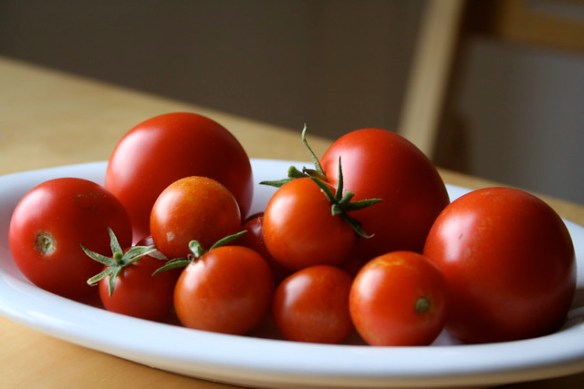
Tomatoes You might want to plant your own tomatoes, this year. Photo by rachelandrew.

Nothing in Biology Makes Sense: Can a creationist be a (public university) biology lecturer?

2010.02.15 - Life Sciences South The Life Sciences building at the University of Idaho. Photo by jby.

Over at Nothing in Biology Makes Sense! I’m confronting my discovery that the University of Idaho, where I received my Ph.D., has hired an outspoken proponent of young-Earth creationism to teach its introductory microbiology course this semester:

I can, at least in principle, imagine a creationist professor who taught the contents of a microbiology curriculum, complete with the common descent of life on Earth, and never breathed a word of his personal beliefs in the classroom. Could Gordon Wilson—of all people—be that “gold-star” creationist?

I decided the only way to answer that question was to ask Gordon Wilson.

Wilson, you may recall, appeared on D&T before, many moons ago. To find out what he had to say for himself, go read the whole thing.◼