Science online, world’s worst amnesia edition

Zebra finches. Photo by Lip Kee.

 ◼

Carnival of Evolution, March 2012

Ladybird beetle on a Joshua tree leaf. Photo by jby.

This month’s edition of the Carnival of Evolution, a regular roundup of all things online and evolutionary, is online at Splendour Awaits. ◼

Do choosy cuckoos choose well-matched hosts?

A reed warbler feeds a cuckoo chick. Photo via Wikimedia Commons.

ResearchBlogging.orgCross-posted from Nothing in Biology Makes Sense.

Brood parasitism, the reproductive strategy of choice for cuckoos and cowbirds, sounds like a lazy approach to parenting: lay your eggs in another bird’s nest, and let the unwilling adoptive parents take the trouble to raise your chicks. But contracting out parental care like this comes with many of its own complications. Chicks raised by parents of a different species have to eliminate competition from their adoptive nestmates, and may grow up a bit confused; reluctant host birds may need to be told, and reminded, that raising cuckoo chicks is an offer they can’t refuse.

But before crossing all those hurdles, a brood parasite’s first task is to lay eggs in the nest of a host who won’t immediately recognize and reject them. The strong natural selection imposed by host rejection has led cuckoos to evolve “host races” that lay eggs whose color and spotting pattern matched to those of their preferred host species. This kind of broad-scale pattern could arise without much direct effort by female cuckoos—those who lay eggs in the nest of the best matching host species would simply be the ones most likely to have chicks that survive to the next generation. But is it possible that cuckoos do take an active role in matching up to their hosts, seeking out host nests containing eggs that look like their own?

The answer, according to a series of studies over the last several years, is yes—probably.

Cuckoo eggs (indicated by arrows) in the nests of three different host species. Illustration via The Knowledge Project.

Although the match between cuckoos’ eggs and those of the specific host species whose nests they invade is striking even to human eyes, it had been generally assumed that, within these egg-matching associations, cuckoos could choose nests pretty much at random. That is to say, while the differences in coloration and spotting between the eggs of different host species were enough to make it hard for a cuckoo egg to blend in with the nests of redstarts and warblers at the same time, a cuckoo whose eggs match the eggs of one redstart will also match the eggs of most other redstarts.

A 2006 study suggested this thinking might be wrong. A group of European ornithologists took advantage of a handy “natural experiment” on the Dutch island of Zealand, where cuckoos had been absent until the early twentieth century. Using museum specimens of cuckoo eggs and eggs from the reed warbler nests in which they were collected, the team compared the match between cuckoo egg color and host egg color over time. Improved matching could be due to female cuckoos selecting better-matched host nests in the new host population; but it could also be created by simple natural selection—the colonizing cuckoos evolving eggs that better matched the host population on average. The coauthors found evidence of rapidly improved matching—but no evidence that the cuckoo’s egg color had changed overall. It looked like the newly arrived brood parasites were adapting by learning, or by evolving, preference for better matches.

Some of the same ornithologists followed this result with a small 2007 study that more directly examined the role of host choice by cuckoos. At a field site in Hungary, they measured the match between cuckoo eggs laid in the nests of great reed warblers, and compared the rate at which warbler parents ejected the naturally-laid cuckoo eggs to the rate at which they rejected randomly-drawn cuckoo eggs introduced into their nests by members of the research team. They found that, indeed, the cuckoo-laid cuckoo eggs were better matches to the eggs in their host nests than researcher-laid cuckoo eggs were—and, more importantly, warblers were less likely to reject the better-matched cuckoo-laid eggs.

A great reed warbler is probably ready for this cuckoo chick to leave the nest. Photo by phenolog.

This result was somewhat complicated, however, by a study just published in PLoS ONE. This time the authors, again including many of the same ornithologists involved in the original 2006 study, compared the match between cuckoo eggs laid in marsh warbler nests at a site in Bulgaria to the cuckoo eggs’ potential match with warbler eggs in nearby unparasitized nests.

If cuckoos were choosing the best-matched host nests, the authors reasoned, there should be a better match between cuckoo eggs and the eggs in parasitized nests than in nearby nests, which the same cuckoo could have used, but didn’t. Six years after the original cuckoo choosiness study, the team was able to use a new approach to compare the match between host and cuckoo eggs: rather than simply compare the spectrum of light reflected by the eggs, they fed the measured spectrum into a mathematical model of bird vision—an approach used in other studies of brood parasites, which is thought to be superior because it estimates how similar, or different, two eggs look through the eyes of a host parent.

With this approach, the team found that cuckoo eggs were not siginificantly better matched to warbler eggs in parasitized nests than they were to eggs in nearby unparasitized nests. Did this overturn the previous evidence for choosy parasitic parents? Well, maybe.

On the one hand, the new study uses the new vision model comparison method, which should give more biologically meaningful results. But on the other, the new study’s design is different in from the 2007 study in a critical way: it doesn’t tell us whether cuckoos’ host choices make the hosts less likely to reject cuckoo eggs. In the 2007 study, there was no need to guess whether the statistical comparison of egg color spectra was biologically meaningful—host parents “told” the researchers that the comparison mattered by rejecting randomly-chosen cuckoo eggs more often than they did eggs laid by actual cuckoos.

So, although there are good reasons to think that the form of measurement used in the new study is better, it’s not clear to me that the result is actually more useful for understanding how natural selection could be acting on cuckoos choosing among many available host nests in a single population. What I’d like to see is a study using the field methods of the 2006 study, and the color matching methods of the 2012 one. ◼

References

Antonov, A., Stokke, B., Fossøy, F., Ranke, P., Liang, W., Yang, C., Moksnes, A., Shykoff, J., & Røskaft, E. (2012). Are cuckoos maximizing egg mimicry by selecting host individuals with better matching egg phenotypes? PLoS ONE, 7 (2) DOI: 10.1371/journal.pone.0031704

Avilés, J., Stokke, B., Moksnes, A., Røskaft, E., Åsmul, M., & Møller, A. (2006). Rapid increase in cuckoo egg matching in a recently parasitized reed warbler population Journal of Evolutionary Biology, 19 (6), 1901-10 DOI: 10.1111/j.1420-9101.2006.01166.x

Cherry, M., Bennett, A., & Moskat, C. (2007). Do cuckoos choose nests of great reed warblers on the basis of host egg appearance? Journal of Evolutionary Biology, 20 (3), 1218-22 DOI: 10.1111/j.1420-9101.2007.01308.x
Science online, naturally selected animation edition

When your legs are adjusting to exercise, so is your brain. Photo by eccampbell.
  • Brains are more like brawn than we thought. Trials in lab rats show that brain tissue can burn glycogen, just like muscle tissue.
  • Ladybuisness with a twist? If vaginal pH can determine vulnerability to infection, should women use acidic tampons, or even douche with lime juice?
  • Evolutionary innoculation. A toxic introduced plant has apparently helped Australian lizards evolve resistance to cane toads’ toxin.
  • Drowning them out under water. New evidence shows that human-created sounds can interfere with whale song.
  • Getting by with a little help from our friends, and our ancestors. Comparing groups of human children, chimpanzees, and capuchin monkeys solving the same puzzle shows that humans get ahead by collaboration.
  • Practical chemistry. Pseudonymous authors point out that it’s not so hard to make cold medecine at home—from crystal meth.

And, via Carin Bondar, a video illustrating evolution using drawings “evolved” by elementary school students.


 ◼

Evolution 2012: Don’t forget your towel

Evolution 2012, the biggest annual meeting of evolutionary biologists, is in Ottawa this year. It’s time to start planning for the trip, and my fellow Tiffin Lab postdoc John Stanton-Geddes was just checking out the accommodation options around the convention centre when he noticed something

Zaphod Beeblebrox? Image from Google Maps.

That’s right. There’s a nightclub named after Zaphod Beeblebrox within walking distance of what will probably be more than two thousand nerds looking for a place to unwind after a long day of PowerPoint and high-intensity schmoozing. Yes, they apparently serve Pan-Galactic Gargle Blasters. (And I also like the philosophy and mission statement.) Here’s hoping my presentation lands early in the conference schedule, because this place looks dangerous, in a good way. ◼

Nothing in Biology Makes Sense: Making sense of spiteful bactera

Photo by Iluisanunez.

This week at the collaborative science blog Nothing in Biology Makes Sense!, contributor Devin Drown discusses a new study of bacterium-on-bacterium violence:

The bacteria produce chemical weapons, bateriocins, which can broadly harm other isolates, but relatives are left unharmed. These chemical weapons can be classified as spiteful: in the process of harming others they also harm the focal individual. This self-harm comes from the cost of making the chemical weapon. Others have labeled this antagonistic trait a greenbeard gene.

To learn what a bacterial chemical weapon has to do with what might otherwise sound like an overenthusiastic celebration of Saint Patrick’s Day—and how both might explain the diversity of living populations, read the whole thing. ◼

Science online, lab-grown hamburger edition

Yosemite National Park. Photo by Genista.

 ◼

Nuking the suspension of disbelief

In my favorite long read of the week, David Shechner of Overthinking It sets out to determine whether Indiana Jones could’ve survived an atomic bomb from the safety of a lead-lined refridgerator, as depicted in The Kingdom of the Crystal Skull.

Spoiler alert: Indy (and the franchise) wouldn’t have survived, in the real world. But exactly how Professor Jones would most likely meet his end is a much more enjoyable question. Here’s a tiny bit:

Sadly, the lead and steel shielding which the authors intend to protect their protagonist from ionizing radiation can itself become a source of it. While beta decay constitutes a relatively small portion of the average nuclear device’s output, what little sprinkle the Frigidaire receives it will transmute, in kind, into an X-ray bath for its inhabitant. It’s sort of like the way a Russian Sauna works, but instead of hot coals there’s a nuclear explosion, and instead of steam there’s a burst of X-rays, and instead of a wood hut it’s a Frigidaire, and also you’re dead. [Link sic.]

As additional evidence of Shechner’s scientific bona fides, he presents the whole analysis in the persona of the third reviewer. I don’t think I’ve enjoyed a takedown of one of George Lucas’s late-career cinematic catastrophes so much since Anthony Lane wrote, in reference to Yoda’s diction in Revenge of the Sith, “break me a fucking give.” ◼

In flour beetles, coevolution mixes things up

A red flour beetle. Photo via Wikimedia Commons.

Cross-posted from Nothing in Biology Makes Sense.

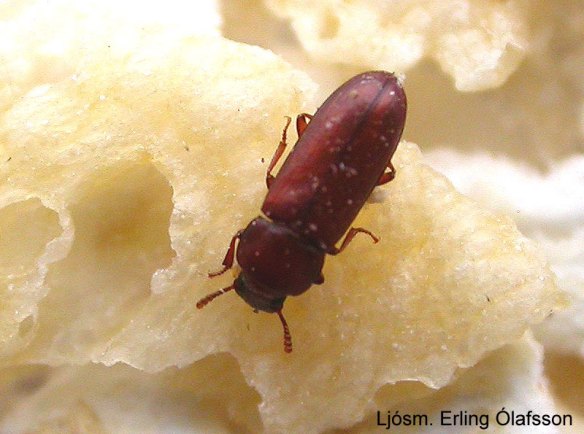
ResearchBlogging.orgWhen evolutionary biologists think about sex, we often think of parasites, too. That’s not because we’re paranoid about sexually transmitted infections—though I’d like to think that biologists are more rigorous users of safer sex practices than the general population. It’s because coevolution with parasites is thought to be a major evolutionary reason for sexual reproduction.

This is the Red Queen hypothesis, named for the character in Lewis Carroll’s Through the Looking Glass who declares that “it takes all the running you can do to keep in the same place.” Parasite populations are constantly evolving new ways to infest and infect their hosts, the thinking goes. This means that a host individual who mixes her genes with another member of her species is more likely to give birth to offspring that carry new combinations of anti-parasite genes.

But although sex is the, er, sexiest prediction of the Red Queen, it’s not the whole story. What matters to the Red Queen is mixing up genetic material—and there’s more to that than the act of making the beast with two genomes. For instance, in the course of meiosis, the process by which sex cells are formed, chromosomes carrying different alleles for the same genes can “cross over,” breaking up and re-assembling new combinations of those genes. Recombination like this can re-mix the genes of species that reproduce mostly without sex; and the Red Queen implies that coevolution should favor higher rates of recombination even in sexual species.

That’s the case for the red flour beetle, the subject of a study just released online by the open-access journal BMC Evolutionary Biology. In an coevolutionary experiment that pits this worldwide household pest against deadly parasites, the authors show that parasites prompt higher rates of recombination in the beetles, just as the Red Queen predicts.

The red flour beetle, Tribolium castanaeum, is named for its predilection for stored grain products. This food preference makes the tiny beetles particularly easy to raise in the lab, where they’ve been useful enough as a study organism to rate a genome project, which was completed in 2008.

Another red flour beetle. Photo via Icelandic Institute of Natural History.

Tribolium castanaeum reproduces strictly sexually. But, like any other biological trait or process, the beetle’s rate of recombination can vary, and evolve. And, as I’ve explained above, the Red Queen suggests that selection by parasites should favor higher rates of recombination. So the authors of the new study set experimental populations of the beetle to evolve either in parasite-free habitats, or under attack by Nosema whitei, a protozoan that infects and kills flour beetle larvae.

The team started experimental populations of beetles (fed on organic flour, natch) in each of the two treatments with eight different genetic lines, maintaining them at a constant population by collecting 500 beetles at the end of each generation to start the next generation. To make the coevolution treatment coevolutionary, the authors also transferred spores of the parasite produced in the previous generation to infect each new generation of beetles.

After 11 generations of coevolution, the authors sampled male beetles from four of the experimental populations in each treatment, and mated them with females from the same genetic line. By collecting the genotypes of the sampled males for a small number of strategically chosen genes, and comparing them to the genotypes of the males’ offspring, it was then possible to identify recombination events—offspring who had combinations of alleles at different genes that weren’t seen in their fathers.

And, indeed, the frequency of recombination—the proportion of offspring whose genetics showed signs of recombination events when compared to their fathers—was greater in the experimental lines that coevolved with Nosema whitei.

That’s a fairly remarkable result for a simple, relatively short selection experiment, and to my knowledge it’s the first of its kind to deal with recombination, as opposed to sex. There are a few study systems in which natural populations show signs of coping with parasites by having more sex, including C.J.’s favorite mollusks, and there is one good experimental example in which the worm Caenorhabditis elegans evolved to reproduce sexually when confronted with bacterial parasites. But this study marks a new bit of empirical support for the Red Queen: coevolution acting to boost the gene-mixing benefits of sex. ◼

References

Kerstes, N., Berenos, C., Schmid-Hempel, P., & Wegner, K. (2012). Antagonistic experimental coevolution with a parasite increases host recombination frequency BMC Evolutionary Biology, 12 (1) DOI: 10.1186/1471-2148-12-18

Morran, L., Schmidt, O., Gelarden, I., Parrish, R., & Lively, C. (2011). Running with the Red Queen: Host-parasite coevolution selects for biparental sex. Science, 333 (6039), 216-218 DOI: 10.1126/science.1206360

Science online, woodrats to camel crickets edition

Careful in that dodgeball game—your competitiveness could activate inflammation. Photo by How I See Life.

 ◼