Mutualist matchmaking made simple

This post was chosen as an Editor's Selection for ResearchBlogging.orgBack in September, I wrote about a new economic model of mutualism that proposed mutualists could keep their partner species from cheating—exploiting the benefits of a mutualistic relationship without returning the favor—without explicitly punishing them, so long as failure to play nice led to a reduction in mutualistic benefit [$a]. Now the same research group has published an elaboration of the economic approach to mutualism in the January issue of The American Naturalist, which suggests that mutualists can recruit better partners by manipulating the cost of entering into partnership [$a].

The bobtail squid, whose mutualism with luminescent bacteria is an example for the new model. Photo by megpi.

As a concrete example for their model, the authors refer to the mutualism between bobtail squid and a species of bioluminescent bacteria, which colonize the squid’s light organ and makes it glow. Short of some kind of complicated squid-bacterium signaling system, how does a squid ensure that its light organ is only colonized by bacterial strains that will pay it back and generate light?

They charge a cover.

Continue reading

Carnival of Evolution No. 31

Photo by kelseyxsunshine.

The 31st edition of the Carnival of Evolution is online at The Dispersal of Darwin—it went up at midnight, New Year’s Day, if I’m not mistaken. In spite of the holiday season, the post list is pretty overwhelming—contributions include Jerry Coyne on reinforcement, John Hawks on the new proto-human genome, Brian Switek on fossils that contributed to evolutionary theory, and Krystal D’Costa on the evolution of gestures for communication.

Check’em out, and tune in next month, when CoE number 32 will be hosted … right here! Submit your posts about evolutionary biology and all its myriad cultural and historical ramifications on the CoE blog carnival form, or e-mail links to denimandtweed AT gmail DOT com.

Denim and Tweed, now with more talkback?

In addition to self-congratulatory navel-gazing, I’m starting the new year with two new features to hopefully make it easier for readers to comment on posts, and contact me directly in a pinch.

The first is the Disqus commenting system, which will let anyone comment using their login identity from Twitter, Facebook, or Yahoo!—or any OpenID system. Disqus has all sorts of shiny social-site integration, so now you can explain what an idiot I am on the site, and then immediately tell all your Facebook friends, too. Give it a try and see what you think!

And if you hate Disqus because it won’t let you log in/ ate your brilliant critique of Disqus/ is the wrong color, you can now e-mail me about those problems at denimandtweed AT gmail DOT com. Messages to that address are forwarded directly to my personal e-mail account, which is not posted on this site.

State of the blog, 2010

Happy New Year, everyone! The year 2010 was another good one for this little corner of cyberspace. As I did last year, I’m going to spend a post quantifying how good the year was.

Weekly visitors to D&T in 2010 (blue line) compared to the same date span in 2009 (green line), as tabulated by Google Analytics.

In 2010, I wrote 184 posts, just over 15 per month. These drew 28,308 pageviews by 18,994 visitors—that’s almost 154 pageviews and just over 103 visitors per post, on average. That’s also more than 1,580 visitors a month, and over 35 percent more than in 2009. This is all given that I actually did a little less posting than in 2009, when I wrote 229 posts.

More navel-gazing after the jump!

The top three Google search phrases (excluding my name and “Denim and Tweed”) bringing visitors to the site in 2010 were “eastern and western yucca trees,” “cuckholding,” and “what makes a species.” Further down the list are “eating tits” and “clitoris,” which I can only imagine result in disappointed searchers.

You were popular, J.B.S., but not as popular as orgasms.

The three most popular posts of 2010 were mostly in the last couple of months of the year. In no particular order, they were about being a gay biologist (which received 368 pageviews in its first two weeks online), J.B.S. Haldane’s ties to the Communist Party (283 pageviews), and the adaptive function (or lack thereof) of female orgasm (599 pageviews). If there’s a common thread uniting those three, I don’t know what it is. The first is among the most personal things I’ve posted here, the second is easily the most ambitious piece I’ve written for D&T, and the third I frankly tossed together as a quick and fun Carnal Carnival contribution. They all benefited from strong interest on Twitter, though, and I’m mighty grateful for the folks who passed on links, especially power-Tweeters Bora Zivkovic and Steve Silberman.

Although D&T is still a side project, I’d like to think I’ve made it a bit more professional and integrated it into my scientific career more solidly this year. I sprang for a unique domain in February, instituted weekly linkfest posts, and—apart from a hiatus for fieldwork and another for being a grad student—kept pretty close to a once-a-week rhythm for science posts. I’ve now cited this blog as a “broader impact” in a couple of grant applications, and link to it directly from the publications list on my professional site. So I guess it’s officially something I do as a scientist.

Have yourself a coevolutionary Christmas

Snow in the Mojave, March 2006. Photo by jby.

… whatever that means. I’m doing the family travel circuit during the traditional worst time of year to travel in the U.S., and taking as much of a break as I can while doing it. Regular posting will resume with the start of the new year. In the meantime, here’s Pink Martini’s rockin’ multilingual rendition of “Auld Lang Syne.”

Under the mistletoe, coevolution is about s and m

This post was chosen as an Editor's Selection for ResearchBlogging.orgPlants and plant products, from sprigs of holly to pine boughs, have been traditional winter holiday decorations since before Christmas became Christmas. Nowadays, if we don’t resort to plastic imitations, we deck our halls with garlands from a nursery and a tree from a farm. But seasonal decorations have natural histories apart from mantelpieces and door frames—ecological roles and, yes, coevolutionary interactions with other species.

Mistletoe. Photo by Ken-ichi.

One good example is mistletoe, whose white berries contrast nicely with holly’s red ones, and whose traditional association with kissing is probably responsible for more holiday party awkwardness than anything short of rum-spiked eggnog. Mistletoes are parasites, rooting in the branches of trees and shrubs to make a living at the expense of those hosts.

This sort of intimate interaction might be expected to result in coevolutionary natural selection between mistletoe and its hosts, potentially creating very specific pairings in which individual mistletoe species are only able to infect one or a few host plants with particular immune responses and defense chemistry. Yet mistletoe is dispersed by birds, which like to eat mistletoe berries, or can carry mistletoe seeds in their feathers—so seeds from a single plant might end up on a wide range of hosts. This means the specificity of mistletoe’s host associations is determined in a tug-of-war between selection from individual hosts and gene flow created by wide-ranging seed dispersal.

In population genetics models, we usually use s to represent selection, and m to represent gene flow, or migration. If s from an individual host species or the local climate is stronger than m, it creates local adaptation to those conditions. But even relatively small m from populations experiencing different conditions can wipe out that local adaptation. So in the case of mistletoe, does s win out, or does m?

One approach to answer this question would be to experimentally infect a range of host plants with a particular mistletoe, and compare their success. But with long-lived host plants, this method would be slow and expensive. Conveniently, local adaptation of mistletoe to individual host species should mean that mistletoe collected from different hosts is more genetically differentiated than mistletoe samples from the same host. And that’s quite a bit easier to test.

A 2002 study [PDF] of one North American mistletoe species found exactly this pattern. Coauthors Cheryl Jerome and Bruce Ford sampled dwarf mistletoe, Arceuthobium americanum from several host trees—Jack pine, ponderosa pine, Jeffrey pine, and two subspecies of lodgepole pine—growing across North America. They found that almost a third of the genetic variation they found in A. americanum was distributed among hosts—that is, it could differentiate dwarf mistletoes collected on one host from dwarf mistletoes collected from another.

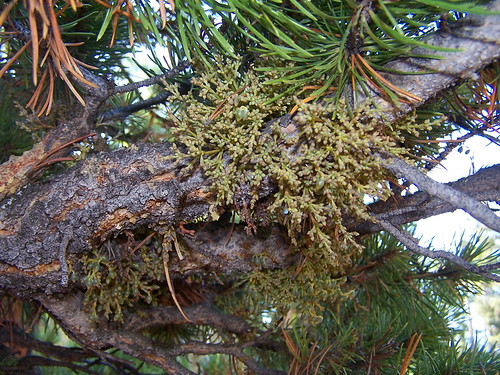
A lodgepole pine branch supporting dwarf mistletoe in the Uinta Mountains, Utah. Photo by Fool-On-The-Hill.

Within these “host races,” geographic distance did have an isolating effect, but the effect was not as strong as that attributable to host differences. When Jerome and Ford examined the population genetics of the three principal A. americanum host trees—Jack pine and the two lodgepole pine subspecies—they found less differentiation than in mistletoe from the same populations [$a]. That suggests that, although coevolution with the trees strongly shapes mistletoe’s genetics, mistletoe infection is only one of many selective pressures acting on the host trees.

Although this approach is frequently used to test for coevolution, it isn’t entirely conclusive. The observed pattern of genetic differentiation in dwarf mistletoe on different host species could also arise if the A. americanum host races have climactic requirements that closely mirror the distribution of their respective hosts, or if birds carrying mistletoe seeds tend not to move the seeds between host species. Other indirect approaches exist to test these alternatives, but (so far as I can find) they haven’t been applied to dwarf mistletoe.

References

Jerome, C., & Ford, B. (2002). The discovery of three genetic races of the dwarf mistletoe Arceuthobium americanum (Viscaceae) provides insight into the evolution of parasitic angiosperms. Molecular Ecology, 11 (3), 387-405 DOI: 10.1046/j.0962-1083.2002.01463.x

Jerome, C., & Ford, B. (2002). Comparative population structure and genetic diversity of Arceuthobium americanum (Viscaceae) and its Pinus host species: insight into host-parasite evolution in parasitic angiosperms. Molecular Ecology, 11 (3), 407-20 DOI: 10.1046/j.0962-1083.2002.01462.x
… what about the idea of loving our enemies?

Kathryn Schulz interviews a evangelical Christian ex-soldier Josh Stieber about his decision to become a conscientious objector. What he was asked to do on the ground in Iraq didn’t square with what he’d been told about that Christ fellow:

It wasn’t too uncommon to abuse prisoners, but I didn’t feel like it was right, so I asked my friend about the American ideals that we grew up hearing about. I said, “Why would you do that to this guy? Isn’t one of the values that we were raised with is that somebody’s innocent until proven guilty?” My friend said, “No, this guy is Iraqi, he’s part of the problem, he’s guilty, and here’s what I want to do to him.” …

I thought back to all the stuff I’d heard sitting next to this guy in church, and I asked him, “Well, even if he is guilty, what about the idea of loving our enemies and returning evil with good and turning the other cheek? How do you reconcile all those teachings?” My friend said, “I think that Jesus would have turned his cheek once or twice but he never would have let anyone punk him around.” Hearing him say it that way just made it sound so ridiculous. Here we supposedly had faith in this guy who very clearly was punked around, and ended up living and dying with sacrificial love.

Stieber also took inspiration from Gandhi. Go now and read the whole thing.

Google’s new reading comprehension filters

Blag Hag Jen McCreight points out that Google is now tagging pages by reading comprehension level. And you can get a nifty little breakdown of pages by comprehension level for individual sites, using Advanced Search.

Denim and Tweed pages, sorted by reading comprehension level.

Standards for comparison are in Jen’s post. Nature.com gets 3%-22%-73%; Blag Hag 90%-9%-0%. I would gloat about D&T’s relative similarity to Nature, but I’m not sure this is the sort of thing about which one gloats.

Posted in Uncategorized | Tagged

Science online, looking forward to #Scio11 edition

Clownfish, anemone—and zooxanthellae makes three. Photo by jby.

First, the latest on ScienceOnline2011: The keynote speaker for the annual online science conference will be Robert Krulwich, the inimitable NPR science correspondent and co-host of Radiolab. And NESCent has announced the winners of its (now annual?) Science Online travel award for science blog posts: How Some Females Respond to Nuptial Gifts by Danielle Lee and Do mother birds play God? by Neil Losin. Go give them, and all this year’s entries, a read.

  • Twenty-eight thousand copies of “Romeo and Juliet.” In one genome. Sequencing the human genome, by analogy to Shakespeare. (The Occam’s Typewriter Irregulars)
  • Take your time, fellows. Men who put on condoms too quickly are more likely to experience “breakage, slippage and erection difficulties.” (NCBI ROFL)
  • Is Yossarianensis taken yet? Online journals are great for rapidly publishing new taxonomic names—but taxonomic descriptions must be published on paper to be “official.” (Open Source Paleontologist)
  • Don’t get your hopes, up just yet, Mom. Some clever genetic shuffling has produced mice with two genetic fathers. (Dan Savage, Wired Science)
  • It’s a regular undersea love-in. The mutual protection relationship of clownfish and sea anemones has another mutualistic wrinkle: anemones’ symbiotic algae benefit from clownfish, um, nitrogenous waste. (Sleeping with the Fishes)
  • X-ray apparatuses, Zeiss microscopes, and fire insurance. That’s what Dr. Skyskull figures scientists wanted for Christmas in 1903, based on ads in a contemporary issue of Nature. (Skulls in the Stars)
  • P(interesting|Bayesianism) = surprisingly high. Nate Silver explains Bayesian logic in the context of the legal travails of Julian Assange. (FiveThirtyEight)

“Birth of a Botfly Maggot”

Mark W. “Dr. Bugs” Moffett presents video of a botfly maggot emerging from under the skin of his hand, then explains the life cycle that leads up to that point. Not suitable for the squeamish, but really not nearly as bad as you might think.

Via io9. See also Robert Krulwich’s classic interview with Jerry Coyne about Coyne’s own botfly birth.