Cool ant! Anyone know what species it is? Anyone? Bueller? Photo by ViaMoi.
Subversive science under Stalin’s mustachioed nose. Artificial selection for human-friendly behavior in foxes on a Russian fur farm also led to physical changes. (Jason Goldman, guest-writing for Scientific American)
Cast off for Science! Dr. Bik of Deep Sea News will be sailing the Gulf of Mexico to study the effects of the recent oil spill on biodiversity there, thanks to new NSF funding—and blogging the whole way. (Deep Sea News)
Wii should really play outside instead. The physical benefits of video “exergames” may be overrated. (Obesity Panacea)
Is your car turned off? Turn it off again. Deborah Blum sets a new stylistic standard for science blogs with a cautionary tale of carbon monoxide poisoning. (Speakeasy Science)
Well, to be fair, they’re really nerdy. Morphology-based identification of species is still important, but no-one wants to actually employ taxonomists these days. (Myrmecos)
Toad versus ants. Invasive ants introduced to the Indonesian island of Sulawesi seem to have met their match in a native, ant-eating toad. (Wired Science)
So that’s what it takes to gross out a lizard. Crickets defend themselves against predators by vomiting and hemorrhaging on cue. (Carin Bondar)
I, for one, welcome our new orca overlords. Killer whales have learned how to hunt and kill great white sharks. (Deep Sea News)
This week’s video was going to be the one about shark-eating whales, until someone decided to illustrate Tom Lehrer’s “Elements” using Google’s shiny new instant-response search. I have my priorities.
Most evolutionary biologists believe that the easiest means for two populations to become reproductively isolated—a first step to splitting into different species—is a physical barrier to movement. Mountain ranges, deep river valleys, or the sheer distance between an island and the mainland—the opportunities for allopatric speciation are all over the place. Unless, of course, you remember that the planet’s largest habitat is the ocean, and there aren’t such obvious physical barriers out at sea.
How do fish and other marine organisms form new species, then? Maybe they’re more likely to speciate as a result of natural selection that varies among otherwise connected marine habitats. For instance, a new study of rockfish finds evidence that this new species in this group usually form by adapting to conditions found at different oceanic depths [$a].
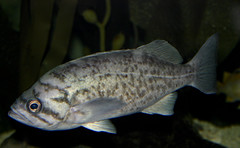
Two rockfish species, Sebastes atrovirens and Sebastes chrysomelas. Photos by brian.gratwicke.
The rockfish genus Sebastes contains several dozen species, but many of them occur in about the same regions of the Pacific ocean. Rather than being separated by physical distance, the group has diversified into different ecological niches, from the intertidal zone down to depths of 600 meters. The new study’s author, Travis Ingram, wanted to determine whether these habitat differences or geographic distance has more often been the cause of rockfish speciation, which he did using two major analyses.
In the first, Ingram asked whether pairs of rockfish species were more or less likely to occupy the same latitudes, and the same depth ranges, as they diverged over time. Allopatric speciation would lead to closely-related rockfish species occupying separate latitude ranges, but Ingram found the opposite. On the other hand, closely-related rockfish species are less likely to live at the same depth in the ocean—so depth, not geographic distance, seems to be important in rockfish speciation.
Ingram’s second analysis takes advantage of the general principle that traits associated with forming new species should change relatively rapidly at about the same time as speciation events, rather than at a uniform rate over time. Traits that undergo this speciational evolution can be distinguished from traits that don’t based on the relationship between trait values of related species. The idea is to compare the trait values for pairs of species drawn from the group of interest—if the differences in trait values are more strongly correlated with the number of speciation events that have occurred since the pair of species last shared a common ancestor than with the raw time since that common ancestry, the trait has probably evolved in speciational fashion.
This is the pattern Ingram found in the depths occupied by different species of rockfish. Changes in depth range occupied by rockfish were associated with speciation events, rather than evolving steadily over time. How these changes could have contributed to reproductive isolation is another question—different depth habitats present rockfish with different kinds of predators and prey, but also with different light environments for visual mating signals. One or more of these environmental differences could create the sort of divergent natural selection that can lead to reproductive isolation and speciation.
Reference
Ingram, T. (2010). Speciation along a depth gradient in a marine adaptive radiation. Proc. Royal Soc. B : 10.1098/rspb.2010.1127
Pretty sure that violates the five second rule. Some well-preserved specimens suggest that wooly mammoths ate their own dung, at least occasionally. (Brian Switek)
You rock, rocks. A newly discovered Burgess Shale outcrop is already yielding freaky new Cambrian Explosion-era fossils. (Wired Science)
Not versed in the social graces. A study of domesticated wolves finds that they’re much slower than domestic dogs to look for guidance from humans. (The Thoughtful Animal)
Afraid you’ve picked up bed bugs during fieldwork? Try baking your clothes in your car. Seriously. (dechronization)
How is a scarab like a mantis shrimp? Scarabs might also be able to see circularly polarized light. (Arthropoda)
So a sense of humor and good conversation does help? Male house finches can compensate for less-attractive plumage by expanding their social circle. (A Scientific Nature)
I know you’re out there. I can smell you eating. Predators can detect the chemical interaction of insect herbivores’ saliva and plant compounds. (Bioblog, original article in Science [$a])
In which a tenured faculty member is literally worse than some baboons. Sexual coercion—and lack thereof—in our evolutionary relatives illuminates a sadly human case study. (The Primate Diaries in Exile)
And now, via Everyday Biology, They Might be Giants on photosynthesis, with a chorus of anthropomorphic insects.
The cover article for last week’s issue of Nature promised to be the last word in a long-running scientific argument over the evolution of cooperation—but it really just rejiggers the terms of the debate. Instead of solving the problem of how cooperative behavior can evolve, the new paper presents a model of maternal enslavement [$a]. These are not, it turns out, quite the same thing.
Group selection versus kin selection
Let’s start with some background. Unselfish, cooperative behavior has long been a puzzle in evolutionary biology, because natural selection should never favor individuals who make significant sacrifices for the benefit of others. Sure, an unselfish individual might expect those she helps to reciprocate later; but a population of the unselfish would be easily overrun by those who don’t reciprocate.
There have historically been two answers to the problem of the selfish out-competing the unselfish. The first case is basically an extension of logic we all learned in kindergarten: cooperative groups can do things that uncooperative groups can’t. Like, for instance, start a neighborhood garden.
Under this model, neighborhoods of cooperative, garden-making people are nicer places to live, and their inhabitants can collectively out-compete other neighborhoods that can’t get it together to start a community garden. In evolutionary terms, this is group selection—even if individuals sacrifice to build the garden, the group as a whole benefits. Unfortunately, this breaks down if the new garden attracts selfish people to move to the neighborhood, buy up all the cheap real estate, and open Urban Outfitters franchises.
There’s another possibility, though. What if unselfish behavior isn’t always truly unselfish? For instance, if you help your relatives, you’re actually helping some of your own genes. You share half your genes with your siblings, a quarter of your genes with half-siblings, an eighth of your genes with first cousins, and so on. This means that Michael Bluth might be on to something.
Evolutionarily speaking, it doesn’t matter if Michael spends all his time helping his feckless family, as long those efforts help someone in the family (G.O.B., most likely) reproduce and perpetuate some of the genes that Michael shares with him or her. This idea was advanced by W.D. Hamilton in two 1964 papers, one mathematical [PDF], and one more focused on real-world examples [PDF]; we now know it as kin selection. It doesn’t hold up so well for maintaining the kind of complex society humans have today, where we interact with lots of completely unrelated people—but it might have got the ball rolling toward the wheel, war, New York and so forth by selecting for cooperative behaviors within small tribes back at the dawn of history.
The group selection versus kin selection debate has gone back and forth for decades, and the new paper is a shot across the bow of kin selection. The authors, Martin Nowak, Corina Tarnita, and E.O. Wilson, aim to do two things: first, prove that kin selection is wrong; and second, describe an alternative explanation. For the first, they argue that kin selection only applies in narrow circumstances, that those circumstances never show up in nature, and that empirical studies just don’t support the model. Johnny Humphreys makes some reasonable objections to these arguments, and so do several folks interviewed by Carl Zimmer, and I’ll refer you there rather than try to improve on them.* I’m more interested in the second part: the alternative explanation.
Enslaved by Mom
No individual fitness for you—you’re cogs in the Superorganism. Photo by jby.
Nowak et al. propose to explain the evolution of unselfishness as it applies to eusociality—organisms like ants or bees or naked mole rats, in which colonies of (closely related) individuals defer most or all of their opportunities to reproduce, in order to support one or a few individuals that reproduce a lot. As Johnny points out in his critique, it’s not clear that eusociality is the same thing as unselfishness at all, even though it’s historically cited as an example of unselfishness [$a]. The new model that Nowak et al. develop actually makes the difference between eusociality and unselfishness even clearer. Under their model, it’s not that worker ants give up reproductive opportunities to help their mother, the Queen, reproduce—it’s that the Queen takes away their reproductive opportunities.
The key insight of the new model is that, in evolving from a non-social insect to a eusocial one, the natural selection that matters affects not the individuals evolving into workers, but the individual who would be Queen. Consider an insect similar to the probable ancestor of ants: females build nests, provision them with food, and lay eggs inside. Nowak et al. propose that a female who evolved the ability to lay “worker” eggs—females that grow up not to found their own nest, but to help in their mother’s—would have greater fitness than females without such helpful offspring.
Aside from the probability of evolving “worker” eggs (which is not a small issue, I think), this shift in perspective from the fitness of the worker to the fitness of the Queen makes all sorts of sense to me. I’ve often wondered why myrmecologists don’t treat ant colonies as single organisms, rather than collections of cooperating individuals.
But this approach also seems to sidestep the key question biologists hope to answer with kin selection and group selection models—these models aim to explain how individuals can come together to cooperate, but Nowak et al. have built a model that looks more like enslavement. I can’t learn anything about how unselfish behavior can spontaneously evolve in a population by looking at a population that has had unselfishness imposed upon it. To indulge in one last especially geeky pop culture reference, it’d be like trying to learn about market economics by studying The Borg.
Nowak, Tarnita, and Wilson might have come up with a very good model for the evolution of eusociality; but if so, it means that eusociality is a bad model for the evolution of cooperation as we usually conceive it.
———— * I will, however, note that Nowak et al. do something I’ve never seen in a scholarly paper before—in dismissing empirical studies of kin selection, they defer substantive discussion to the Supplementary Information. There are, in fact, 43 pages of SI for this 6-page paper, including two major mathematical models and the discussion of empirical kin selection studies. This is a problem, but one that is beyond the scope of this already-long post.
References
Axelrod, R., & Hamilton, W. (1981). The evolution of cooperation. Science, 211 (4489), 1390-1396 DOI: 10.1126/science.7466396
Hamilton, W.D. (1964). The genetical evolution of social behaviour. I. Journal of Theoretical Biology, 7 (1), 1-16 DOI: 10.1016/0022-5193(64)90038-4
Hamilton, W.D. (1964). The genetical evolution of social behaviour. II. Journal of Theoretical Biology, 7 (1), 17-52 DOI: 10.1016/0022-5193(64)90039-6
Nowak, M., Tarnita, C., & Wilson, E. (2010). The evolution of eusociality. Nature, 466 (7310), 1057-62 DOI: 10.1038/nature09205
There’s already been a lot of blogospheric discussion of the BBC’s recent declaration that “Darwin may have been wrong” based on a recently-published paleontology paper. I hadn’t paid it much attention, because while sloppy science journalism irritates me, it’s not quite in my wheelhouse, expertise-wise. Then I actually got around to reading the paper, and it turns out that it’s directly related to some of my own work—and the conclusion that led to the sensationalistic sub-headline doesn’t make any sense.
Coauthors Sahney, Benton, and Ferry analyze the fossil record of four-limbed vertebrates—tetrapods—to show that in general, as more species evolve, they also evolve to fill a wider variety of ecological roles [$a]. Ecological roles are here defined by combinations of body size, diet, and habitat. (Sahney et al estimate there are 207 such combinations possible, though only 75 are “occupied.”) That’s a straightforward and mostly unsurprising result—the number of tetrapod species increases as tetrapods evolve new ways to make a living. But then we get to the conclusions of the paper, and things get weird. Sahney et al. conclude that because diversification is associated with finding unoccupied ecological roles, competition is mostly unimportant in the diversification of tetrapods: “Given the unrestricted access tetrapods have to ecospace, perhaps there is little need for competitive interactions to shape diversification.” In other words, if diversification happens by finding ways to make a living that aren’t already occupied, competition isn’t important.
Except that the very reason species diversify following an ecological opportunity like the development of a new ecological role is the lack of competition the new role provides. As my coauthors and I documented in a recently published literature review, competition shapes the kind of diversification documented by Sahney et al. in two ways: first, by its absence following the evolution of a new lifestyle; then in spurring an adaptive radiation as new species evolve to partition up the newly-available “ecospace.”
What makes this doubly odd is that Sahney et al. refer to another kind of ecological opportunity, the extinction of competitors, as a good example of competition-driven diversification. But a central insight of the literature on ecological opportunity is that diversifying because a whole bunch of ecological roles have just opened up is not fundamentally different from diversifying after a new mutation makes a never-before-seen ecological role possible. Think of it like starting a new business: to avoid competition, you could either sell an existing product in a place where no one else sells that product, or you can invent a product no one else offers. Both approaches give you a market all to yourself, and both are defined by competition.
It’s hard for me to understand why Sahney et al. don’t make this conceptual connection—which, for what it’s worth, has its roots in The Origin of Species.
References
Sahney, S., Benton, M., & Ferry, P. (2010). Links between global taxonomic diversity, ecological diversity and the expansion of vertebrates on land. Biology Letters, 6 (4), 544-7 DOI: 10.1098/rsbl.2009.1024
Yoder, J.B., Des Roches, S., Eastman, J.M., Gentry, L., Godsoe, W.K.W., Hagey, T., Jochimsen, D., Oswald, B.P., Robertson, J., Sarver, B.A.J., Schenk, J.J., Spear, S.F., & Harmon, L.J. (2010). Ecological opportunity and the origin of adaptive radiations Journal of Evolutionary Biology, 23 (8), 1581-96 DOI: 10.1111/j.1420-9101.2010.02029.x
It’s the hot new pigment this season. A just-discovered form of chlorophyll allows the algae that produce it to photosynthesize using infrared light. (Wired Science)
One, two, three … many? Studies of monkeys, babies, and chickens suggest that the ability to count small numbers is innate, and separate from the ability to count larger numbers. (The Thoughtful Animal)
Can you hear me now? On the Galapagos islands, marine iguanas listen for the alarm calls of mockingbirds to know if a predator is approaching. (The Thoughtful Animal)
Crocodile tears from the Adaptationist Programme. Crying confers fitness advantages by eliciting empathetic responses. Or something like that. (NPR)
Long-term forecast: 60% chance of dueling results. Remember all that oil in the Gulf of Mexico that hadn’t magically disappeared? Analysis of DNA microbial DNA sampled in that oil plume just found lots of oil-eating bacteria. (Deep Sea News, Wired Science, NPR; original peer-reviewed article in Science [$a])
Climate’s changing, with or without you. As temperatures warm throughout the Mojave Desert, Joshua tree, my favorite woody monocot, may disappear from 90% of its present range. (Voltage Gate)
I start another semester as Teaching Assistant for Mammalogy next week, so here’s David Attenborough discussing mammalian dentition, with reference to an ancient omnivore I’d never heard about up to now.
Two of the most diverse groups of living things on Earth are flowering plants and the insects that make their living from flowering plants. Biologists have long thought that the almost incessant, intimate interactions between plants and plant-eating insects might be the evolutionary cause of each group’s spectacular diversity. On a smaller scale, this means that we’re interested in the reasons that specific insects and plants interact in the first place—what evolutionary trails leads one insect species to specialize on a single host while others eat pretty much any plant they land on.
A new study of one group of plant-eating insects suggests that the kind of interaction between insects and their host plants also determines how specific those interactions are. Examining a group of moths that, like the yucca moths I study, pollinate their host plant and then eat some of its seeds, the authors of the new study find that related, non-pollinating moths use more host plant species than the pollinators [$a]. I think it makes a particularly nice companion piece to my post about the evolutionary origins of yucca moths, because it provides an example of one or two other things biologists can deduce from phylogenies—and, as we’ll see, some things they can’t.
Epicephala: like a yucca moth without the snappy name
The moths in question are in the genus Epicephala, and they have an obligate pollination relationship with trees in the genus Glochidion, a diverse group of plant species found in southern Asia. That is, female moths carry pollen between Glochidion flowers in special mouthparts, deliberately apply pollen to the flower, and then lay eggs in the flower so that, when it develops into a fruit, her larvae can eat some of the seeds inside. Epicephala species are highly specialized, with most species only using one species of Glochidion [$a]. That’s a higher degree of specialization than what’s seen in yucca moths, in fact.
Pollinating moths (genus Ephicephala, left) use fewer host plant species than related non-pollinating moths (genus Caloptilia, right). Photos by CharlesLam and Bettaman.
The family of which Epicephala is a member happens to include other moths that interact with Glochidion, but only as herbivores: species in the genera Caloptilia and Diphtheroptila, whose larvae all eat Glochidion leaves. Do these antagonistic moths use more, or fewer, species of the host plant than the mutualistic Epicephala? Kawakita and his coauthors set out to answer that question by reconstructing the phylogenies of Caloptilia and Diphtheroptila. Finding species in evolutionary trees
Most biologists agree that two groups of organisms are separate species if there is no gene flow between them. A consequence of genetic isolation between species is that, if they’re isolated long enough, they become monophyletic within phylogenies. That is, all the individuals within each species share a common ancestor that is not shared with any other species. You can see this by contrasting two monophyletic species (on the left in the figure below) with two groups that turn out to be paraphyletic—some individuals of the red species are more closely related to individuals of the blue species than to other individuals of their own species.
Monophyletic and paraphyletic groupings. Image by jby.
The reasoning behind this is a bit subtle. Paraphyletic groups might still be separate species—they just haven’t been isolated long enough to become monophyletic. As a good example, I’m a coauthor on a recent study that did this kind of analysis on non-pollinating “bogus” yucca moths that use three different yucca species. In that case, the moths were paraphyletic with respect to which yucca species they used, but more analysis showed that there is currently very little gene flow between moths using different hosts [PDF].
In the case of the Glochidion-using Caloptilia and Diphtheroptila, Kawakita et al. found something more complicated. Each genus broke up into several monophyletic groupings, or clades of genetically similar individuals—but in most cases each clade included moths collected from at least two different Glochidion species. Kawakita et al. note that the clades also correspond to differences in the moths’ wing coloration, larval feeding behavior, and genitalia, and conclude that each clade is a different species. That would mean that the two antagonist genera tend to use multiple host plants.
Interesting question, but is this the way to answer it?
Except I’m not sure I buy this usage of phylogenies to define species. Kawakita et al. have shown that within the clades they call species, the individuals all have very similar genetics, but only for the two commonly-used genetic markers from which the phylogenies are reconstructed. It’s not impossible that within each clade the moths might be adapted to individual host plant species, and reproductively isolated by that adaptation—and this could have happened recently enough that not many genetic differences would have built up in the two markers.
To really answer the question Kawakita et al. have posed would require a study of each clade in the two antagonist genera at a much finer scale. The question of how specialized Caloptilia and Diphtheroptila are hinges on how many species are in each genus, and that’s better addressed by examining population genetics, not ancient relationships among these genera.
Reference
Drummond, C., Xue, H., Yoder, J., & Pellmyr, O. (2009). Host-associated divergence and incipient speciation in the yucca moth Prodoxus coloradensis (Lepidoptera: Prodoxidae) on three species of host plants. Heredity, 105 (2), 183-96 DOI: 10.1038/hdy.2009.154
Kawakita, A., & Kato, M. (2006). Assessment of the diversity and species specificity of the mutualistic association between Epicephala moths and Glochidion trees. Molecular Ecology, 15 (12), 3567-81 DOI: 10.1111/j.1365-294X.2006.03037.x
Kawakita, A., Okamoto, T., Goto, R., & Kato, M. (2010). Mutualism favours higher host specificity than does antagonism in plant-herbivore interaction. Proc. Royal Soc. B, 277 (1695), 2765-74 DOI: 10.1098/rspb.2010.0355
Right now there’s a single page listing recent feed results from all these group blogs, and another devoted to science-y blog carnivals, but no independent blogs (ahem), and no particular way of sorting through the contents. It looks more like a starting point than a finished product, and that’s just fine—Bora and his co-founders Anton Zuiker and Dave Munger are still looking for input. Says Dave:
The site is really just an aggregator of aggregators. Everything you see on the front page is a feed from some other bundle of blogs. In a couple cases, we made our own bundles using Friendfeed. The site is flexible enough to add additional bundles as bloggers and publishers form new blogging communities. It’s not ideal — I think the ultimate science blog aggregator will allow users to view blog posts by topic, and perhaps have some way of identifying the best posts. But it’s flexible enough that with some input from the community, we might be able to shape it into something really special. Check it out, and let us know what you think.
As a blogger without a network, I’m naturally interested in seeing independent blogs added to the ScienceBlogging.org stream (although, as Bora points out, we’re already partially accounted for by including the Research Blogging feed). The large number of indy science bloggers would make this challenging, to say the least, but I think many of the issues are the same ones that show up, in smaller scale, on the new ScienceBlogging.org homepage—how to make it easy for a visitor to sift through a large number of posts to find writing by particular people, on particular topics, written in a particular time-frame.
Maybe what’s needed is an analogue to ResearchBlogging that aggregates all posts from member blogs and sifts them into topic-labeled feeds—but that’s a whole different class of infrastructure, and effort from member blogs, than what’s provided at the new site right now. Still, the value of a true one-stop shop for online science writing should be great enough to justify the effort. In the meantime, I’ve added a new bookmark, and I’ll be keeping an eye on ScienceBlogging.org.
A brand-new blog carnival promises to unleash the naughtier impulses of the science blogosphere which, let’s be frank, were never particularly tightly leashed to begin with. Except for the ones that are into that sort of thing.
Ahem.
Anyway, the inaugural edition of the Carnal Carnival is now online at A Blog Around the Clock, where host Bora Zivkovic called for any and all posts relating to poop, feces, dung, and/or excreta. The only shit-related question left unanswered in this fecund roundup is, shouldn’t they have saved this topic for Carnal Carnival #2?
 Cool ant! Anyone know what species it is? Anyone? Bueller? Photo by ViaMoi.