2013 Twin Cities Marathon, in photos

So, that marathon I ran this morning? Went pretty damn well. My official time is 3 hours 19 minutes 55 seconds, which is a personal record marathon time—by about ten minutes! I attribute this to (1) spectacular autumnal weather—clear, cool, and perfect for running; (2) some half-arsed attempts at speed training I did over the winter; and (3) actually paying attention to my pacing, instead of my usual marathon strategy of just running as fast as I can until I end up barely able to walk the last mile.

I didn’t do much tweeting from the course, but I did take a bunch of photos—the camera on my new iPhone is a lot better than my old one. So here they are, with a reconstructed transcript of my internal dialogue:

Continue reading

Marathoning, yet again

Tomorrow morning I’m running the Twin Cities Marathon—a mere two and a half years, and three other marathons, after I moved to the Twin Cities. What can I say? Scheduling is tricky.

I’ll be bringing my phone, so there may be live-tweeted photos if I’m feeling comfortable enough for that. Certainly the forecast—cool and cloudy but not actually raining—is perfect weather for both a very long run and for nice photos of the prettiest parts [PDF] of Minneapolis and Saint Paul. But I’m really hoping to crack my current time record of about 3 hours 30 minutes, so the only mid-race updates may be the ones available via the marathon website.

In the meantime, I have one last very short run to go do, to keep the ol’ joints loose.◼

Science online, shutdown edition

Aedes aegypti mosquito A safer DEET successor can’t arrive soon enough. Photo by Sanofi Pasteur.

Nothing in Biology Makes Sense: On the origins of bacon

Pig Photo by mgabelmann.

Over at Nothing in Biology Makes Sense! Noah Reid takes a look at a new study of the recent evolutionary history of pigs:

Domestic pigs are in the family Suidae, which includes the babirusas, warthogs, the endangered pygmy hog (whose generic name is, Porcula, seems a likely candidate for America’s next tragic children’s cereal) and the domestic pig’s close relatives in the genus Sus. Depending on where you draw the lines, there are around 7 species in Sus. With the exception of the wild boar (Sus scrofa) their natural ranges are restricted to Southeast Asia west of Wallace’s Line.

Because domestic pigs are prone to going feral and getting, um, re-familiarized with their wild relatives, unravelling their history using genetic data is tricky business. To see what the new study found, go read the whole thing.◼

The Molecular Ecologist: Interview with Loren Rieseberg

Sunflower (closely) Photo by ToOb.

This week at The Molecular Ecologist, we’re kicking off a new interview series, “People Behind the Science,” by John Stanton-Geddes. The inaugural interview is with Loren Rieseberg, the Chief Editor of Molecular Ecology and an expert in the evolutionary consequences of hybridization between species.

When I arrived at Washington State University (WSU) in the fall of 1984 to begin my PhD, my advisor, Doug Soltis, handed me a copy of Verne Grant’s Plant Speciation and told me to find a problem. I was especially intrigued by Grant’s discussion of the potential role of hybridization in adaptation and speciation.

The interview ranges from Rieseberg’s philosophy for Molecular Ecology to which one paper (out of over 300 he’s authored!) that he wishes more people would read. So go read the whole thing.◼

Science online, black hole at the (other) end of the universe edition

Beer Trio Horizontal Dude, if you don’t brew it in your gut, you can’t really appreciate the bouquet. Photo by Lindsey Gira.
  • This week at The Molecular Ecologist: Take your coding to the next level with Software Carpentry.
  • And, at Nothing in Biology Makes Sense! Taking a big-data approach to understand the role of reproductive isolation in species formation?
  • New update from Queer in STEM: Examining the outness of queer folks at STEM workplaces.
  • “This collection is among the first to reveal all major evolutionary stages of feather development in non-avian dinosaurs …” Dinosaur feathers found preserved in amber.
  • Best or worst infection ever? A brewer’s yeast infection of the gut can make the ultimate micro-brew.
  • Gee whiz. An editor at Nature goes right off the rails.
  • One jab to rule them all? The basis for a “universal” flu vaccine may finally have been found.
  • Optical illusion of the week. Here is a moth that looks like a leaf with curling edges.
  • With charts! Why infographics are bad for conveying, you know, info.
  • Sure, why the hell not? Did the universe begin in a five-dimensional black hole?
  • Whew. Turns out that distance running doesn’t increase your risk of arthritis.

Nothing in Biology Makes Sense: Can we separate reproductive isolation and species formation?

fork in the road Photo by dkwonsh.

This week at Nothing in Biology Makes Sense! Noah Reid takes a look at a study that attempts to disentangle the effects of reproductive isolation between species and the rate at which new species are formed. Why would you want to do that? So you can tell whether the former causes the latter!

RI [reproductive isolation] is often thought to be important in diversification because some theory predicts that even low levels of intermating between populations can prevent divergence from occurring and because hybridization between divergent populations can cause them to homogenize, or cause one population to become extinct. If these factors commonly prevent speciation or cause incipient species to go extinct, one might expect a positive correlation between the rate of evolution of RI and DR [species diversification]. This paper is the first test of this prediction.

But, of course, a lot of biologists would say that the evolution of reproductive isolation is the evolution of a new species … so things get a bit complicated. Go read the whole thing, and see what you think.◼

Queer in STEM: Out of the lab closet?

Image via Queer in STEM.

The latest update about the results of the Queer in STEM survey looks at how open participants are in personal and professional contexts:

… for many of us, coming out is a daily task. Still, how out we are in a given situation or social group says a lot about how comfortable we are in that context.

We found that people tend to be less out to colleagues than to friends and family—but we also found some interesting patterns about what factors might determine how open participants can be when they come to work. To find out what those patterns are, go read the whole thing.◼

Science online, butterflies lost, found, and drawn edition

2008.11.28 - Heliconius melpomene Wallace didn’t collect this one. Photo by jby.
  • This week, at The Molecular Ecologist: In some viruses, mutation rates may be shaped by simple population dynamics.
  • And, at Nothing in Biology Makes Sense! Do African herbivores run for their dinner, or for their lives?
  • Bookmarked! A step-by-step guide for getting started with Github.
  • What is this, 1920? No, we humans haven’t freed ourselves from natural selection.
  • Because where else would it want them? Here is an insect with gears in its legs.
  • Good news: they’re nothing new. Bad news: they’re nothing new. A brief history of human fretting about pimples.
  • Found by a seventeen-year-old, too. Some butterflies collected by Alfred Russell Wallace, then apparently lost in a fire, have turned up in Oxford.
  • Yep, they have it. The latest approach for reconstructing past environmental condition involves whales’ earwax.
  • And how they link to animals’ physiology. A nice description of plant immune responses.
  • Eyeing the exits is never a good sign for the thing you’re exiting. No, PhDs looking at non-academic careers is not a sign that we should make more PhDs.
  • Vladimir Nabokov: He could write, he could catch butterflies, he could handle a colored pencil a little.
  • “She was a professor?” Yeah, but she was an adjunct.

Nothing in Biology Makes Sense: Your dinner, or your life?

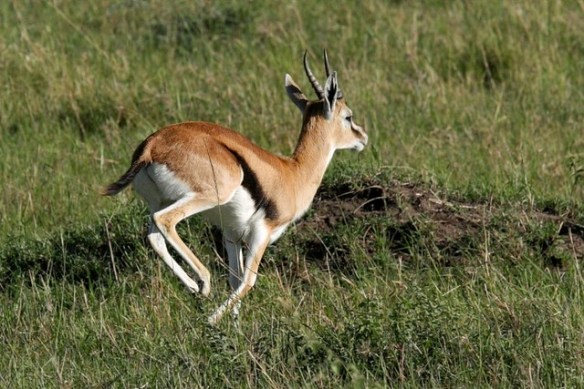
2010 076 Masai Mara b 24 Photo by ngari.norway.

Over at Nothing in Biology Makes Sense!, I’ve written about a new study that tries to disentangle conflicting sources of natural selection to determine whether big herbivores like antelope, zebras, and ostriches have evolved to run because they’re always running away from predators.

An antelope’s frame is under more demands than evading cheetahs—it also needs to travel long distances to follow food availability with the shifting rainy season. In fact, the North American fossil record suggests that big herbivores on that continent evolved long legs for distance running millions of years before there were predators able to chase after them. And then again, not all predators run their prey down; lions, for instance, prefer to pounce from ambush.

To find out whether gazelles are running for their lives, or running for dinner, go read the whole thing.◼