Studio 360 spends this week’s entire episode on the biography of Nikola Tesla, the pioneer of electrical engineering who went head-to-head with Thomas Edison over the alternating current standard, cured Mark Twain’s constipation, and may well have been the original Dr. Strangelove. It’s good radio.
Category Archives: science
Moralizing unhelpful? What a silly idea!
This week’s NY Times Magazine cover story is a thoughtful exploration of the emerging scientific understanding of human morality. It covers a lot of the same ground as one of my favorite RadioLab episodes (including an interview about trolley car ethics with Joshua Greene), but goes beyond the simple biology to ask whether there is a universal human grammar of morality, and consider what insights that hypothesis could lend to modern hot-button ethical issues like global warming. The concluding suggestion is that moralizing an issue might actually be counterproductive:
In many discussions, the cause of climate change is overindulgence (too many S.U.V.’s) and defilement (sullying the atmosphere), and the solution is temperance (conservation) and expiation (buying carbon offset coupons). Yet the experts agree that these numbers don’t add up: even if every last American became conscientious about his or her carbon emissions, the effects on climate change would be trifling . . . [effective measures against climate change] will have to be morally boring, like a carbon tax and new energy technologies, or even taboo, like nuclear power and deliberate manipulation of the ocean and atmosphere.
Trees ditch mutualist ants when herbivory stops

Ant domatium on Acacia. Photo by Alastair Rae.
In this week’s issue of Science: African Acacia trees reduce support for a mutualistic species of ant when they aren’t experiencing herbivory [abstract only without subscription]. Normally, the whistling thorn tree (Acacia drepanolobium) enlists the help of an ant, Crematogaster mimosae, to fight off large herbivores and harmful insects. It works like this: The tree attracts ants by providing sugary nectar from glands at the base of its leaves and balloonlike growths called domatia (see photo), which the ants use for shelter. The ants attack anything that tries to eat the tree, for the very reasonable (and selfish) reason that it’s also their nest. It seems like a mutually beneficial arangement, but no one has tested the hypothesis that, if the trees no longer need defense, they’ll stop “paying” their ants to stick around.
Palmer et al. do exactly that by comparing ant provisioning on trees in plots that are fenced in (preventing access by big herbivores) with trees in control plots that aren’t. After ten years inside the fence, they found that Acacia trees had reduced their nectar output and the rate at which they developed new domatia. The mutualistic ants, dependent on these rewards, were displaced by another species, C. sjostedti, which doesn’t need nectar or domatia, but also doesn’t defend the tree as much.
None of the changes in trees’ provisioning for ants are the result of immediate natural selection – the time over which this happened is considerably less than one generation for Acacia. This is individual trees “judging” that they no longer need ant protection because they’re not under attack, a response that is expected to evolve over long periods of balancing the need for protection against the cost of provisioning ants. Another ant species that uses Acacia nectar and domatia, C. nigriceps, didn’t suffer from the lack of large herbivores, probably because it prunes the trees it occupies, which the authors think may be enough to make the tree “think” it’s still being eaten.
Reference:
Palmer T.M., M.L. Stanton, T.P. Young, J.R. Goheen, R.M. Pringle, and R. Karban. 2008. Breakdown of an Ant-Plant Mutualism Follows the Loss of Large Herbivores from an African Savanna. Science 319:192-5.
The science ticket
Via the essential beatfinger: Wired Science summarizes Science’s assessment of how the Republican and Democratic presidential candidates stand on science issues. These include support for science funding in general, support for embryonic stem cell research, acceptance of evolution, plans for improving science education, and willingness to address global warming. Barack Obama comes out on top of the Democrats, but the differences between him and Hillary Clinton or John Edwards seem mainly related to emphasis. Among the Republicans, the list-makers seem to have had difficulty coming up with anything nice to say: Rudy Giuliani gets credit just for being pro-choice!
Foster care raises I.Q.
NY Times: A newly-released study compares cognitive development of children raised in orphanages with those raised entirely by foster families, and those moved from institutional to foster care. Key findings: foster care is associated with better cognitive development (measured for the study in terms of I.Q.), and the negative effect of institutional care is offset by the transition to foster care, with more benefit at younger ages. For the full details, see the original paper on Science‘s website [subscription required]. Yes, this is one of those studies that seems intuitively obvious, but it’s always useful to test intuition, especially in matters of government policy. As a bonus, this is also strong evidence in support of a large effect of early environment on I.Q. scores.
Red means stop?

New in the Journal of Evolutionary Biology: An article asks whether autumnal leaf colors could act as a deterrent to insect herbivores [abstract free; subscription needed for more].
It may seem odd to think that trees could be interested in defending leaves that are about to drop off anyway; but the authors’ idea is that trees with brighter red leaves are signaling a “commitment” to producing more defensive chemicals in next year’s leaf crop. To test this hypothesis, the authors measured aphids’ preference for leaf color in the fall, and whether fall leaf color predicted aphids’ performance on the same trees in the spring.
The aphids showed a significant preference for green autumn leaves over red, but there was no correlation between fall color and aphid performance on the next spring’s leaves. So, interesting idea, but no dice. The authors say, reasonably, that their results suggest aphids’ color preferences have more to do with finding the most nutritious leaves in the fall than avoiding defensive chemicals in the spring.
It’s important to note that this result is not necessarily coevolution, in the strict sense of reciprocal natural selection between the aphids and the trees. The aphids seem to have adapted to their host plant, but it’s not clear (base on this study, anyway) that the aphids exert significant selection on the plant in return.
Reference:
Ramirez, C. C., B. Lavandero, and M. Archetti. 2008. Coevolution and the adaptive value of autumn tree colours: colour preference and growth rates of a southern beech aphid. Journal of Evolutionary Biology 21:49-56.
Googlepedia will have experts!
Google recently announced its response to Wikipedia, a collection of webpages called “knols,” so called because they’ll be discrete chunks of knowledge. The announcement on the official Google blog puts a lot of emphasis on the way in which knols are not Wikipedia with a link to Gmail in the top corner: expert authors. Knols will be written by people who already have a reputation connected to the relevant subject, with prominent attribution for contributors.
It’s an interesting idea. First, it should prevent people and organizations from tweaking entries to suit their PR preferences (unless, of course, the Pentagon gets to write its own knol). Second, it could be a great opportunity for academics to make their work accessible to the lay audience that doesn’t have university-provided access to the journal sites. Disseminating your work to the unwashed masses looks good on grant applications (filed under “broader impacts”), and lord knows we can all use the practice at explaining our work in common sensical terms.
At this early stage, knols contributions are invitation-only. Hey Google! Want a knol about Joshua trees?
The rising tide of I.Q.
The New Yorker’s Malcolm Gladwell has a short but worthwhile column about James Flynn’s observation that worldwide I.Q. test scores are rising, and its implications for the interpretation of I.Q. in general. Gladwell takes the opportunity to snipe at William Saletan’s recent defacement of Slate.com with a series of columns on race and I.Q., which (after stirring up a hurricane of scorn on Slate’s reader forum) culminated in a sad non-apology when Saletan’s main source turned out to be a known white supremacist.
Important = ?

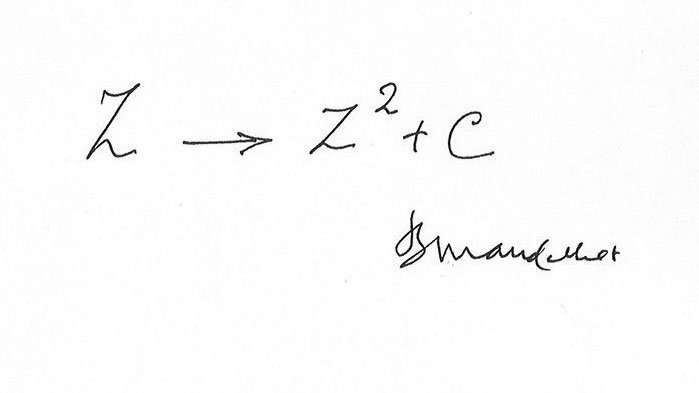
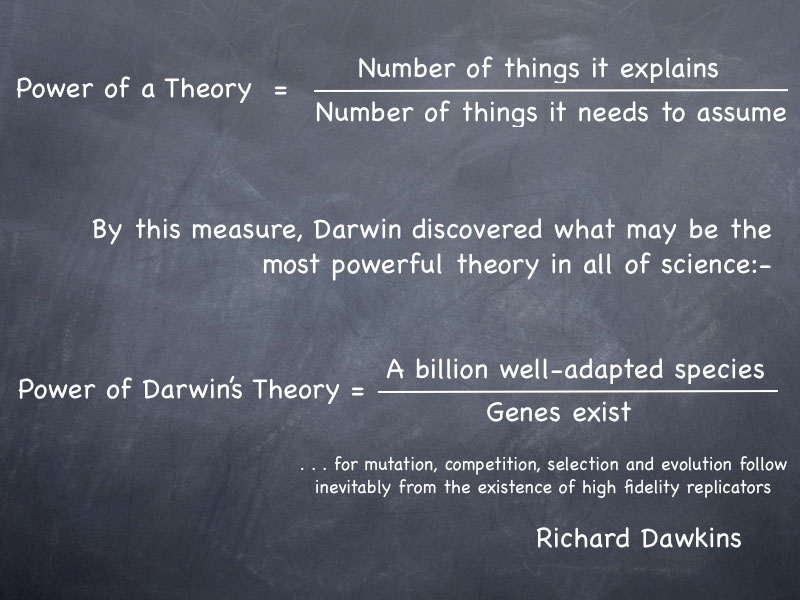
Edge asks a list of luminaries to describe their equation or algorithm and gets a wide range of results, from truistic to the inscrutable. I have owe a nod to the elegance of Richard Dawkins’s response, but my favorite is, I think, Stephen Pinker’s, which has more “wow” factor.


Viva Al
Gore Shares Peace Prize for Climate Change Work – New York Times
Over at Slate, former Gore staffer Mickey Kaus gives him his due, and Christopher Hitchens begs him to run.
Wired just reprints AP coverage.
Morning Edition goes for blanket coverage.