Open Lab 2010 finalists: I’m in a book!

More specifically, my post about J.B.S. Hadane’s involvement in a Soviet propaganda film featuring the revival of a severed head will be included in the Open Lab 2010 anthology of online science writing. It’s a huge honor to be chosen alongside such an incredible list of writers from such a long list of awesome submissions.

As one of forty volunteer reviewers, I know how stiff the competition was, and how hard the final decisions must have been. I only have an inkling, though, of the amazing effort editor Jason Goldman put in to sort through all the submissions, coordinate reviews, and develop a final list.

The cover design for the final print volume will apparently be unveiled at Science Online 2011 (which is next weekend!), and the book itself will be available for purchase once all the submissions are revised for dead-tree formatting.

Science online, decline of the “decline effect” edition

Bumblebee. Photo by je-sa.

Mutualist matchmaking made simple

This post was chosen as an Editor's Selection for ResearchBlogging.orgBack in September, I wrote about a new economic model of mutualism that proposed mutualists could keep their partner species from cheating—exploiting the benefits of a mutualistic relationship without returning the favor—without explicitly punishing them, so long as failure to play nice led to a reduction in mutualistic benefit [$a]. Now the same research group has published an elaboration of the economic approach to mutualism in the January issue of The American Naturalist, which suggests that mutualists can recruit better partners by manipulating the cost of entering into partnership [$a].

The bobtail squid, whose mutualism with luminescent bacteria is an example for the new model. Photo by megpi.

As a concrete example for their model, the authors refer to the mutualism between bobtail squid and a species of bioluminescent bacteria, which colonize the squid’s light organ and makes it glow. Short of some kind of complicated squid-bacterium signaling system, how does a squid ensure that its light organ is only colonized by bacterial strains that will pay it back and generate light?

They charge a cover.

Continue reading

Carnival of Evolution No. 31

Photo by kelseyxsunshine.

The 31st edition of the Carnival of Evolution is online at The Dispersal of Darwin—it went up at midnight, New Year’s Day, if I’m not mistaken. In spite of the holiday season, the post list is pretty overwhelming—contributions include Jerry Coyne on reinforcement, John Hawks on the new proto-human genome, Brian Switek on fossils that contributed to evolutionary theory, and Krystal D’Costa on the evolution of gestures for communication.

Check’em out, and tune in next month, when CoE number 32 will be hosted … right here! Submit your posts about evolutionary biology and all its myriad cultural and historical ramifications on the CoE blog carnival form, or e-mail links to denimandtweed AT gmail DOT com.

Under the mistletoe, coevolution is about s and m

This post was chosen as an Editor's Selection for ResearchBlogging.orgPlants and plant products, from sprigs of holly to pine boughs, have been traditional winter holiday decorations since before Christmas became Christmas. Nowadays, if we don’t resort to plastic imitations, we deck our halls with garlands from a nursery and a tree from a farm. But seasonal decorations have natural histories apart from mantelpieces and door frames—ecological roles and, yes, coevolutionary interactions with other species.

Mistletoe. Photo by Ken-ichi.

One good example is mistletoe, whose white berries contrast nicely with holly’s red ones, and whose traditional association with kissing is probably responsible for more holiday party awkwardness than anything short of rum-spiked eggnog. Mistletoes are parasites, rooting in the branches of trees and shrubs to make a living at the expense of those hosts.

This sort of intimate interaction might be expected to result in coevolutionary natural selection between mistletoe and its hosts, potentially creating very specific pairings in which individual mistletoe species are only able to infect one or a few host plants with particular immune responses and defense chemistry. Yet mistletoe is dispersed by birds, which like to eat mistletoe berries, or can carry mistletoe seeds in their feathers—so seeds from a single plant might end up on a wide range of hosts. This means the specificity of mistletoe’s host associations is determined in a tug-of-war between selection from individual hosts and gene flow created by wide-ranging seed dispersal.

In population genetics models, we usually use s to represent selection, and m to represent gene flow, or migration. If s from an individual host species or the local climate is stronger than m, it creates local adaptation to those conditions. But even relatively small m from populations experiencing different conditions can wipe out that local adaptation. So in the case of mistletoe, does s win out, or does m?

One approach to answer this question would be to experimentally infect a range of host plants with a particular mistletoe, and compare their success. But with long-lived host plants, this method would be slow and expensive. Conveniently, local adaptation of mistletoe to individual host species should mean that mistletoe collected from different hosts is more genetically differentiated than mistletoe samples from the same host. And that’s quite a bit easier to test.

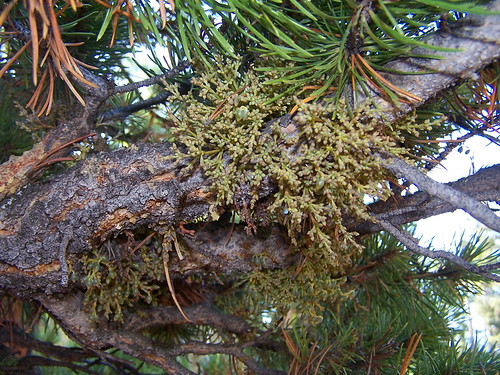
A 2002 study [PDF] of one North American mistletoe species found exactly this pattern. Coauthors Cheryl Jerome and Bruce Ford sampled dwarf mistletoe, Arceuthobium americanum from several host trees—Jack pine, ponderosa pine, Jeffrey pine, and two subspecies of lodgepole pine—growing across North America. They found that almost a third of the genetic variation they found in A. americanum was distributed among hosts—that is, it could differentiate dwarf mistletoes collected on one host from dwarf mistletoes collected from another.

A lodgepole pine branch supporting dwarf mistletoe in the Uinta Mountains, Utah. Photo by Fool-On-The-Hill.

Within these “host races,” geographic distance did have an isolating effect, but the effect was not as strong as that attributable to host differences. When Jerome and Ford examined the population genetics of the three principal A. americanum host trees—Jack pine and the two lodgepole pine subspecies—they found less differentiation than in mistletoe from the same populations [$a]. That suggests that, although coevolution with the trees strongly shapes mistletoe’s genetics, mistletoe infection is only one of many selective pressures acting on the host trees.

Although this approach is frequently used to test for coevolution, it isn’t entirely conclusive. The observed pattern of genetic differentiation in dwarf mistletoe on different host species could also arise if the A. americanum host races have climactic requirements that closely mirror the distribution of their respective hosts, or if birds carrying mistletoe seeds tend not to move the seeds between host species. Other indirect approaches exist to test these alternatives, but (so far as I can find) they haven’t been applied to dwarf mistletoe.

References

Jerome, C., & Ford, B. (2002). The discovery of three genetic races of the dwarf mistletoe Arceuthobium americanum (Viscaceae) provides insight into the evolution of parasitic angiosperms. Molecular Ecology, 11 (3), 387-405 DOI: 10.1046/j.0962-1083.2002.01463.x

Jerome, C., & Ford, B. (2002). Comparative population structure and genetic diversity of Arceuthobium americanum (Viscaceae) and its Pinus host species: insight into host-parasite evolution in parasitic angiosperms. Molecular Ecology, 11 (3), 407-20 DOI: 10.1046/j.0962-1083.2002.01462.x
Science online, looking forward to #Scio11 edition

Clownfish, anemone—and zooxanthellae makes three. Photo by jby.

First, the latest on ScienceOnline2011: The keynote speaker for the annual online science conference will be Robert Krulwich, the inimitable NPR science correspondent and co-host of Radiolab. And NESCent has announced the winners of its (now annual?) Science Online travel award for science blog posts: How Some Females Respond to Nuptial Gifts by Danielle Lee and Do mother birds play God? by Neil Losin. Go give them, and all this year’s entries, a read.

  • Twenty-eight thousand copies of “Romeo and Juliet.” In one genome. Sequencing the human genome, by analogy to Shakespeare. (The Occam’s Typewriter Irregulars)
  • Take your time, fellows. Men who put on condoms too quickly are more likely to experience “breakage, slippage and erection difficulties.” (NCBI ROFL)
  • Is Yossarianensis taken yet? Online journals are great for rapidly publishing new taxonomic names—but taxonomic descriptions must be published on paper to be “official.” (Open Source Paleontologist)
  • Don’t get your hopes, up just yet, Mom. Some clever genetic shuffling has produced mice with two genetic fathers. (Dan Savage, Wired Science)
  • It’s a regular undersea love-in. The mutual protection relationship of clownfish and sea anemones has another mutualistic wrinkle: anemones’ symbiotic algae benefit from clownfish, um, nitrogenous waste. (Sleeping with the Fishes)
  • X-ray apparatuses, Zeiss microscopes, and fire insurance. That’s what Dr. Skyskull figures scientists wanted for Christmas in 1903, based on ads in a contemporary issue of Nature. (Skulls in the Stars)
  • P(interesting|Bayesianism) = surprisingly high. Nate Silver explains Bayesian logic in the context of the legal travails of Julian Assange. (FiveThirtyEight)

Coevolutionary constraints may divide Joshua trees

Scientists love it when the real world validates our more theoretical predictions. It helps, of course, if those predictions are rooted in the real world to begin with. This is more or less what happened in my own research, with results reported in two just-published scientific papers. In the first, which I discussed last week, my coauthor and I showed that some kinds of species interactions can reduce the diversity of the interacting species [PDF]. Today, I’m turning to the second, in which my coauthors and I found exactly this predicted pattern in one such species interaction, the pollination mutualism between Joshua tree and yucca moths.

The new paper, published this month in the Journal of Evolutionary Biology, examines the phenotypic variation of two forms of Joshua tree and the two different moth species that pollinate it. The data show that although the Joshua trees pollinated by different moths are very different from each other, those pollinated by the same moth species are extremely similar [PDF].

Two forms of Joshua tree pollinated by different moth species, seen here side by side, don’t vary much among themselves. (Flickr: jby)

This is a nice confirmation of the theory paper because it strongly suggests that coevolution between mutualists like Joshua tree and its pollinators works the way the theoretical model assumes it does, with natural selection favoring individuals who best match their partners in the other species.

Continue reading

Science online, yawning opossums edition

Opossums eat lots of disease-carrying ticks. So that’s one thing they’re good for. Photo by graftedno1.

Remember that story about NASA having discovered bacteria using arsenic in place of phosphorous? UBC microbiologist Rosie Redfield ripped into the data underlying that conclusion on her blog RRResearch. (She’s also writing to the journal.) Redfield’s complaints and others prompted a lot of discussion about the the trouble with over-publicized science—see David Dobbs at Neuron Culture and Carl Zimmer on Slate, as well as Zimmer’s comprehensive roundup of scientific criticism of the study. Slate also took the opportunity to re-post an old piece on problems with peer review, but, as Chris Rowan wisely pointed out at Highly Allochthonous, peer review continues after a paper is published, especially in the case of “cutting edge” results like this one.

Meanwhile, in non-arsenic-based science news:

  • “… like the appendix … only more fun.” Scicurious tackles the question of whether female orgasm is adaptive. (Neurotic Physiology)
  • Save the ‘possums. The relationship between mammal diversity, tick host use, and the risk of Lyme disease spread to humans (previously discussed on D&T), rendered into charming narrative form. (EcoTone)
  • Short answer: cancer isn’t smallpox. Why haven’t we cured breast cancer yet? (White Coat Underground)
  • Ho-hum. I mean, wow. Yawning is measurably “contagious” for adult humans, chimpanzees, and dog—but not for children under the age of five. (The Telegraph)
  • Get out and play. Sitting around all day is worse than simply not exercising. (Obesity Panacea)
  • They’re all legs men. Like many other animal species, deep-sea octopodes practice multiple paternity. (SouthernPlayalisticEvolutionMusic)
  • “It’s not just kids who are bullying. Adults are stacking the deck.” Gay teens—especially openly gay teens—”suffer disproportionate punishments by schools and the criminal-justice system.” (Blogtown, NY Times; original article in the journal Pediatrics)

And now, via Craig McClain of Deep Sea News, video that answers the pressing question of what happens when an alligator attacks an electric eel. Don’t watch this if you don’t want to end up feeling bad for the alligator.

Not all species interactions are (co)evolved equal

Biologists have long thought that coevolutionary interactions between species help to generate greater biological diversity. This idea goes all the way back to The Origin of Species, in which Darwin proposed that natural selection generated by competition for resources helped cause species to diverge over time:

Natural selection, also, leads to divergence of character; for more living beings can be supported on the same area the more they diverge in structure, habits, and constitution, of which we see proof by looking at the inhabitants of any small spot or at naturalised productions.
—Darwin (1859), page 128.

In the twentieth century, this idea was extended into suggestions that coevolution between plants and herbivores or flowers and pollinators helped to generate the tremendous diversity of flowering plants we see today. In general, biologists have found that strong coevolutionary interactions are indeed associated with greater diversity.

Yet although there is a well-established association between coevolution and evolutionary diversification, correlation isn’t causation. Furthermore, every species may coevolve with many others, and diversification that seems to be driven by one type of interaction might actually be better explained by another. It has even been suggested that coevolution rarely causes speciation at all.


Species interact in a lot of different ways, as antagonists, competitors, and mutualists. Do all these interactions shape diversity the same way? (Flickr: jby)

One step toward determining how often coevolution promotes diversification would be to identify what kinds of coevolutionary interaction are more likely to generate diversity. This is precisely the goal of a paper I’ve just published with Scott Nuismer in this month’s issue of The American Naturalist. In it, we present a single mathematical model that compares a wide range of species interactions to see how they shape diversification, and that model shows that coevolution doesn’t always promote diversity [PDF].

Continue reading

Science online, inhospitable conditions edition

Precarious, yes, but he’s protecting his sperm count. Photo by Ed Yourdon.
  • Don’t roast your junk, dude. Scicurious takes on the recent study showing that laptop computers can raise dudes’ scrotal temperatures, putting their sperm at risk. (Neurotic Physiology)
  • In case you needed another reason to hate them. A grad student specializing in mutation repair mechanisms considers the risk of the TSA’s new X-ray backscatter body scanners. (My Helical Tryst)
  • Too late to change the name to Phoenix? The neuroscience blog carnival Encephalon is back, in spades. (A Blog Around the Clock)
  • It’s that time of year again. Bora kicks off the lead-up to ScienceOnline 2011 with a series of posts introducing registered participants. (A Blog Around the Clock)
  • More than cat videos. Jonathan Eisen lists the ways blogging and microblogging have contributed to his scientific career. (The Tree of Life)
  • Actually, it’s just an eternal dissertation defense. Neuroskeptic imagines what scientific Hell would be like. (Neuroskeptic)
  • Waterproof sunscreen, anyone? Depletion of the ozone layer may mean whales are at greater risk of sunburn—and skin cancer. (Mental Floss, original article in Proc. Royal Soc. B)
  • Preadaptation for the win. One of the few Australian predators that can tolerate invasive cane toads is a snake that may have evolved the tolerance in response to selection from toxic prey in its ancestral range. (Oh, For the Love of Science)
  • NASA has not found extraterrestrial life. But it has found bacteria that use arsenic in place of phosphorous, which means there’s one more form extraterrestrial life could take. (Nature News, NY Times, Not Exactly Rocket Science; original article in Science [$a])

Regarding that last item, I’ll give the final word to good ol’ xkcd.

Comic by xkcd.