Science online, colony collapsing crocodiles edition

Bees: still not doing well. Photo by net_efekt.

Nothing in Biology Makes Sense: Making sense of polar bears’ origins

Polar bear. Photo by ucumari.

This week at the collaborative blog Nothing in Biology Makes Sense, contributor Noah Reid goes in-depth on the recent study pinpointing the historical origins of polar bears, and why it’s taken the most recent systematic methods to correctly pinpoint them.

From 2008 to 2010, a series of algorithms were published that could take data from multiple genes and infer the history of whole populations, a drastic improvement over previous methods that could only identify the history of single genes (e.g. mtDNA). With these methods in mind, a group of researchers gathered data from 14 nuclear genes for multiple extant brown and polar bear populations (Hailer 2012). … the new data analyzed with the new method suggested that polar bears diverged far earlier than previously thought (around 600 thousand years ago) and that they were no longer closely related to the southeast Alaska population, but rather to the common ancestor of all brown bear populations.

For more details, including a nice brief explanation of why it can be important to use multiple genes in reconstructing relationships among species, go read the whole thing.◼

And then eventually …

… the winding, inefficient, undirected trajectory of evolution lands on a new selective optimum. Video via ABC:

video platform video management video solutions video player

Well said, Mr. President. Welcome to the majority.◼

The Three Laws of Mitt Romnics

Mitt. Photo by davelawrence8.

Following up on my tweet from yesterday, here’s my best guess at the Three Laws of Mitt Romnics. (With deepest apologies to the memory of Isaac Asimov.)

(1) Mitt Romney may not injure a corporation or, through inaction, allow a corporation to come to harm.
(2) Mitt Romney must obey the orders given to him by conservative Christians, except where such orders would conflict with the First Law.
(3) Mitt Romney must protect his own integrity as long as such protection does not conflict with the First or Second Laws.

In the spirit of nerdy completeism, the Zeroth Law of Mitt Romnics is, of course: Do whatever it takes to get elected President.◼

Evolution is undirected, political evolution doubly so

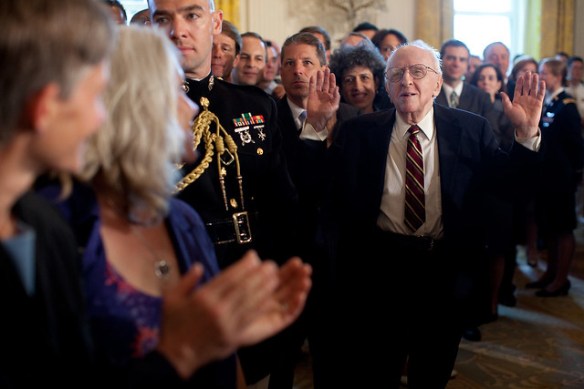
Pioneering gay rights activist Frank Kameny, at a White House event to commemorate his work. Photo from the White House photo stream.

To everyone wringing their hands over the Obama Administration’s weird collective dance around the question of marriage equality: You do know that evolution is an inherently undirected, frequently random, ultimately goal-less process, right? In which case, the President’s description of his position as “evolving” is an exceptionally apt fit for the inefficient waffling, contradictory signals, and even reversal of previous positions that we’ve observed over the last several years.

See, doesn’t that make you feel better?

Yeah, me neither.

How about this as a kicker instead: evolutionary changes that appear to be directionless over short periods of time may eventually turn out to be part of much longer-term trends.◼

And another thing …

Regarding that adaptive fairytale about the “runner’s high”—over at Distributed Ecology, Ted Hart points out that it doesn’t make much sense in phylogenetic context, either.

What would be really interesting is to see where this trait maps across the phylogeny. Is it a conserved trait that was selected for in some ancestor? That would point to the fact that maybe it has nothing to do with running. The authors are mute about phylogeny, but eCB’s could alternatively be the ancestral character state, and really the interesting question is why did ferrets evolve the loss of this state? On the other hand maybe the trait evolved multiple times, and that also is really interesting to ask how that happened. But either phylogenetic scenario undermine the central thesis of Raichlen.

You’ll want to read the whole thing, natch.◼

Dr. Pangloss runs a marathon

Runners in the 2009 New York Marathon. Photo by Whiskeygonebad.

ResearchBlogging.orgThis just came over Twitter (hat tip to @DLiancourt): NPR is running a story claiming that the “runner’s high” some of us feel after a good workout is an adaptation to prompt us to keep fit, or something.

When people exercise aerobically, their bodies can actually make drugs—cannabinoids, the same kind of chemicals in marijuana. [University of Ariona anthropologist David] Raichlen wondered if other distance-running animals also produced those drugs. If so, maybe runner’s high is not some peculiar thing with humans. Maybe it’s an evolutionary payoff for doing something hard and painful, that also helps them survive better, be healthier, hunt better or have more offspring.

So, in a study [$a] pubished in The Journal of Experimental Biology, Raichlen tested this adaptive hypothesis by comparing the levels of these “endogenous cannabinoids” in the blood of humans, dogs, and ferrets after running on a treadmill. The idea being that the ancestors of dogs, like ours, made a living by running—chasing down prey—while ferrets don’t.

So it’s kind of nice to see that Raichlen and his coauthors did, indeed, find that humans and dogs both had higher levels of endogenous cannabinoids in their blood after a run, and the ferrets didn’t. That’s a useful evolutionary data point: it suggests that whatever physiological system prompts endogenous cannabinoid production in connection with exercise dates to (at least) the common ancestor of dogs and humans, and that its preservation in both species may be linked to our shared ability to run long distances.

But it really doesn’t show that this cannabinoid response is an adaptation to reward us for putting in our daily miles.

To really show that the runner’s high is an adaptation, of course, we’d need data that showed (1) observed variation in the runner’s high response has a genetic basis, and (2) people who had get stronger runner’s highs have more babies. But even apart from that, the understanding of what is good for us today—getting off our butts and going for a run—isn’t particularly that well connencted to the lives of our proto-human ancestors. Does Raichlen really think that early humans (or dogs, or any other animal that chases down prey) would just sit around and go hungry if we didn’t have a cannabinoid payoff at the end of the hunt?

And then, in the text of the very same NPR article, an orthopedic surgeon is quoted saying that the “runner’s high” can actually be a problem:

[Dr. Christina] Morganti treats runners for injuries and she says they’re the worst patients. “The treatment is to stop running,” she says. “They won’t. They don’t want to. A lot of the behavior is not unlike the patients we have who are seeking drugs. It’s really similar. It’s an addiction.”

So … a physiological response that prompts some of us to run even when running is likely to exacerbate injury is a good thing? How, exactly, would giving yourself shin splints lead to greater reproductive fitness if you’re making a living hunting gazelles on the savannah? I’m going to go out on a limb and say it wouldn’t.

Here’s an alternative hypothesis, which I freely admit is no better supported by the available data: the endogenous cannabinoid response isn’t a “reward” for running. Instead, it helped our ancestors tolerate the stress of running when they needed to, by letting them ignore minor pains and press on after that one elusive, tasty antelope. For our ancestors, dinner was the reward for running, not the cannabinoids. In the modern world, where we don’t run for our dinners, we’ve re-purposed the pleasant persistance of those cannabinoids as a motivation to replace that original life-or-death need.

Whatever the actual evolutionary origins of the “runner’s high,” the idea that it’s an adaptive reward for exercise is nothing more than adaptive storytelling filtered through the lens of our modern, very unnatural, lives. Don’t get me wrong—I love to run, and in fact I’m a month away from my fourth marathon. But I’m not going to pretend that I’ll be running those 26.2 miles because natural selection wants me to.◼

Reference

Raichlen, D., Foster, A., Gerdeman, G., Seillier, A., & Giuffrida, A. (2012). Wired to run: exercise-induced endocannabinoid signaling in humans and cursorial mammals with implications for the ‘runner’s high’ Journal of Experimental Biology, 215 (8), 1331-6 DOI: 10.1242/jeb.063677
The living rainbow: The selective benefit of a fa’afafine in the family

ResearchBlogging.orgOne of the key evolutionary puzzles of same-sex sexuality, as it manifests in modern, Western human societies, is that those of us attracted to members of our own biological sex don’t make a lot of babies. I’ve already spent a lot of pixels on the question of how genes for same-sex attraction might persist in human populations in the face of that selective cost—but a paper just published in PLoS ONE adds some evidence in favor of one popular hypothesis: that gene variants that make men more likely to be gay could also make their straight relatives more fertile.

The new paper presents data from Samoa, where the traditional culture has long had a place for men who are attracted to other men, in the role of fa’afafine—literally, men who “live in the manner of women.” Samoan boys who show interest in feminine activities are recognized by their families as members of this “third gender,” which is more like the modern Western conception of transgender identity than what we call “gay.” Fa’afafine often present and dress like straight women, and as adults, they generally have relationships with straight-identified men. But fa’afafine aren’t exactly “transgendered” as we understand that concept in the West—they don’t have the sense that their bodies don’t match their gender identity.

The fact that Samoan culture accommodates and accepts same-sex sexuality makes it an especially interesting context for testing hypotheses about the evolution of queer sexuality, including the idea that relatives of fa’afafine might be more fertile than people with no fa’afafine in the family. The study’s coauthors surveyed Samoan fa’afafine and straight men, asking how many children their grandmothers, aunts, and uncles had had. And they found that grandmothers of fa’afafine—both maternal and paternal grandmothers—had more children than grandmothers of the straight-identified men they interviewed.◼

Reference

VanderLaan, D., Forrester, D., Petterson, L., & Vasey, P. (2012). Offspring production among the extended relatives of Samoan men and fa’afafine. PLoS ONE, 7 (4) DOI: 10.1371/journal.pone.0036088

Science online, diverse botanical evolution edition

Wind turbines. Photo by ali_pk.

Carnival of Evolution, May 2012

Photo by NS Newsflash.

This month’s issue of the Carnival of Evolution, which collects online writing about Darwin’s dangerous idea and all its variously modified descendents, is online over at John S. Wilkins’s blog Evolving Thoughts. Highlights include, but are not limited to, an attempt to trace the origin of the phrase “social Darwinism,” discussion of how sloths and turtles evolved to move slowly, and whether the diet of early humans was more healthy than ours. Go now and read the whole thing.◼